Intensities: Mike Mentzer, Tom Platz and effective/affective training
Intensity is the measurement of affect; it is the body’s vibratory motion and resonation before it becomes a conscious emotion or feeling – Brian Massumi
A spectre is haunting the science – or art – of hypertrophy. The spectre of Mike Mentzer. Or should that be Tom Platz? It depends where you stand. Is changing your body on a metabolic, chemical and cellular composition level in ways that are dramatically visible, palpable, and measurable an art or a science? Bodybuilding stimulates cellular signaling for growth, metabolic reprogramming toward improved energy utilization, and chemical changes in DNA and proteins that support increased muscle mass, strength, and endurance, etc. – which very much sounds like science, right?
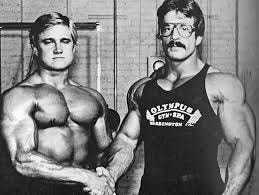
But is making all of that happen a matter of science or a matter of art, or of something else? There have been – and continue to be – many opinions about this. But the most famous and stark illustration of the art/science dispute was embodied by the different approaches to bodybuilding advocated by (the older) Mike Mentzer and (the younger) Tom Platz.
Mentzer competed from the very end of the 1960s through to the very early 1980s. Platz emerged through the 1970s and was at the top of his game in the 1980s. Both developed world class physiques, but the way they did so was very different.
In fact, Platz and Mentzer represent not merely different training protocols, but fundamentally opposed philosophies of the body, knowledge, and human potential.
Taken together, they are especially interesting, as both figures developed sophisticated theoretical frameworks that extended far beyond sets and repetitions and out into questions of epistemology, ontology, and ethics. Let’s take Mentzer first.
Mentzer: ‘One Valid Theory’
Mentzer is widely credited with attempting to make bodybuilding more scientific. He found the seeds and structure for his philosophy in the work of Ayn Rand’s philosophy of ‘objectivism’. I will not get into the weeds of Rand’s philosophy, but I’ll show my cards and say that I personally don’t regard it as ‘philosophy’, and think of it rather more as a kind of self-help psychology. To my mind (and the minds of many others), its tenets all sound strong, but they don’t really hold water. Which is not to say that I don’t quite like it. As interesting rules of thumb for living well, I would include Rand in the group of perennially popular stoic and pragmatist philosophers who seem to offer tips and principles for living well. But, when it comes to her political philosophy… well now, that’s a different matter.
Anyway, from Rand, Mentzer took her insistence that there is only one reality or one truth, that all we have in the face of this is reason, and that what we do with all of this is a matter of our individualism. From this, Mentzer created a training system, which he called Heavy Duty. This was explicitly constructed as a rational-scientific endeavour grounded in the principle that there can be only one valid theory of the body and bodybuilding. Drawing parallels to physics, medicine, and mathematics, Mentzer argued that reality does not contradict itself, and therefore only one set of principles – which, for him, had to be intensity, brevity, and infrequency – could constitute valid training methodology.
With this philosophical stance, Mentzer became bodybuilding’s arch-rationalist. He appealed not only Rand but also to ancient Greek philosophers and rejected what he termed the ‘evil’ of Immanuel Kant, whom he accused – following, and in the exact same manner as Rand (who was not afraid of hyperbole and whose philosophy always strikes me as being expressed in the mode of a kind of seething moralism, hugely irked and annoyed at the world) – of undercutting humanity’s confidence in ‘reason’. (Already, with Rand, ‘continental’ philosophy is being blamed for perceived social problems – in a kind of foreshadowing of today’s witch-hunt in the USA against those who teach, say, critical race theory or the social constructionist arguments about gender that are based in the work of Judith Butler or indeed understandings of biology that are more advanced than middle school level.)
In Randian terms, for Mentzer, training was a manifestation of rational self-interest: the application of logic to achieve biological adaptation through precisely calibrated stimulus. His famous insistence that ‘one set’ taken ‘to failure’ is sufficient for hypertrophy represented more than training advice – it was an epistemological claim about how we know what produces growth, privileging deductive reasoning over empirical volume.
However, Mentzer’s rationalist edifice conceals some arguably significant internal contradictions. First, his insistence on a ‘singular valid theory’ is in conflict observationally with the massive inter-individual variability in training adaptation documented by contemporary exercise science. Scholarship – especially recent scholarship (which, of course, Mentzer was not privy to) – demonstrates that mechanical loading parameters interact with complex psycho-emotional, genetic, and contextual factors to produce highly individualized responses. The claim that one universal prescription exists contradicts empirical evidence showing equivalent muscle hypertrophy from vastly different training volumes and frequencies.
Second, Mentzer’s ‘objectivism’ led him toward a problematic epistemological reductionism. His philosophy treated the body as a mechanistic system responding to quantifiable stimuli in predictable ways. Contemporary periodization theorist John Kiely terms this the ‘mechanical loading-determines-adaptation’ fallacy. The problem, that is, is that Mentzer’s tenet ignores the (now-recognized – admittedly, not then established) role of neurobiological context, stress interpretation, and psycho-emotional factors in shaping physical adaptations. The lived, phenomenological body resists reduction to Mentzer’s rational calculus.
Third, critics note that Mentzer’s Heavy Duty rhetoric also served commercial interests. He promoted Arthur Jones’s Nautilus equipment and arguably needed to differentiate his approach in a crowded marketplace. His dogmatic insistence on methodological purity – training only once every 4-7 days with single sets – arguably appears suspiciously aligned with selling efficiency and specialized equipment rather than reflecting biological necessity. More damning than this observation or suspicion, quite a few bodybuilders went on to testify that Mentzer himself actually trained with higher volume earlier in his career, only adopting extreme minimalism later when promoting his philosophy became financially lucrative.
Finally, Mentzer’s rationalism exhibits what philosopher Michael Polanyi identified as an ‘anti-traditional prejudice’ – assuming that reasoned analysis can always improve upon accumulated practical wisdom. His dismissal of high-volume methods practiced successfully by countless bodybuilders arguably represents a failure to recognize what epistemologists call tacit knowledge: embodied understanding that resists complete articulation in propositional form.
Tom Platz: Experiential Intensity
On the other hands, Tom Platz’s philosophy occupies entirely different conceptual terrain. Where Mentzer pursued rational efficiency, Platz embraced maximal experiential intensity. His training was characterized by extremely high volume, extraordinarily high repetitions (for instance, famously squatting 500+ pounds for 20+ reps), and a distinctive philosophy or convictions that located growth not in minimal effective stimulus but in transcending mental and physical barriers through suffering.
Platz’s approach aligns with existential and phenomenological traditions that are entirely other than Mentzer’s objectivism. His famous dictum ‘embrace the pain’ and his descriptions of squatting being like ‘like church on Sunday’ indicate an approach to training in which it is to be understood more as a form of lived spiritual practice rather than mechanical optimization. Platz always emphasized mind-muscle connection, visualization, and what phenomenologists might recognize as pre-reflective bodily awareness. His training philosophy integrated Greek ideals of kalos kagathos (beautiful and good), positioning bodybuilding as an aesthetic art form expressing inner virtue through outer symmetry.
Crucially, Platz’s philosophy acknowledges dimensions that Mentzer’s rationalism excludes: pain as generative, suffering as transformative, and the irreducibly subjective quality of intense physical experience. His assertion that you have to achieve failure, and to push beyond and beyond and beyond reflects an investment in the idea that growth emerges through confronting existential limits – what Heidegger might term authentic engagement with one’s thrownness in the world.
Nonetheless, Platz’s investment in phenomenological intensity also raises serious questions. First, his philosophy risks what we might call ‘suffering fetishization’ – the potentially dangerous conflation of productive training stimulus with maximal subjective distress. Contemporary exercise science seems to demonstrate time and again that, actually, there is no necessary relationship between experienced pain intensity and hypertrophic stimulus. (In this respect, the contemporary commentator, Mike Israetel, argues that Platz’s extreme methods may work for ‘genetic’ outliers but prove counterproductive for most lifters, leading to injury and inadequate recovery – although the invocation of ‘genetics’ is at once a bodybuilding cliché and – when it comes out of Israetel’s own mind – ‘scientifically’ regressive.)
Second, Platz’s discourse also exhibits many of the features of romanticized individualism, and is almost entirely divorced from scientific (or other) principles of almost any kind. His training philosophy celebrated intuition, personal experience, and artistic expression, but it resisted systematic analysis. This creates what philosophers of science term an underdetermined methodology: practitioners lack clear principles for distinguishing effective practices from superstition. Without rational frameworks, training becomes purely experiential and non-transferable.
Third, Platz’s intensity-through-volume philosophy involves a pragmatic contradiction at the physiological level. As critics note, performing 52 sets for arms (as Platz-era bodybuilders did) necessitates pacing oneself – a performative contradiction that undermines the claim of maximal intensity that Platz advocated. Full intensity and extreme volume exist in inverse relationship: you cannot sustain absolute effort across marathon training sessions. Platz’s synthesis of both may have succeeded due to pharmaceutical enhancement more than philosophical coherence.
Finally, Platz’s phenomenological approach lacks engagement with its own power dynamics. His celebration of suffering as ennobling ignores how gym culture’s valorisation of pain can become coercive, particularly for marginalized bodies. Feminist critiques, for instance, have been known to highlight how bodybuilding’s suffering discourse often reinforces hegemonic masculinity and excludes alternative embodied experiences.
Conclusion: From science and feeling to affect
In many ways, a spectrum with Mentzer at one and Platz at the other is one of the main (but not the only) spectrum within which the lived, embodied, performed and explored hypertrophy approaches that constitute bodybuilding still elaborates itself.
Both philosophies intuitively make a lot of sense, but exhibit fundamental epistemological weaknesses when examined critically. Mentzer’s rationalism or scientism assumes that deductive reasoning from physiological principles can determine optimal training. But this ignores the complexity and path-dependence of biological adaptation. Exercise science increasingly recognizes that training adaptations emerge from interactions between mechanical stimuli, psycho-emotional context, genetic variation, training history, and numerous unmeasured (unmeasurable?) variables. No single approach can capture this complexity – successful training requires practical wisdom (phronesis) that integrates principles with individualized adjustment.
Platz’s phenomenology, on the other hand, conversely privileges first-person experiential knowledge but lacks mechanisms for intersubjective validation. The subjective intensity of suffering tells us nothing reliable about underlying physiological processes. As phenomenologists of pain note, there exists a persistent appearance/reality problem: felt experience may misrepresent actual tissue states and growth stimuli. Platz’s approach risks what we might term ‘experience inflation’ – mistaking intense conscious suffering for the training ‘working’.
Both also exhibit what certain hypertrophy scientists identify as ‘path dependence’ – the tendency for prior beliefs and commercial incentives to constrain conceptual innovation. Mentzer needed to sell a system differentiating him from Arnold-era volume training. Platz needed to justify his extreme methods as ‘art’ rather than potentially reckless overtraining. Neither could fully escape the social construction of bodybuilding knowledge within particular historical and economic contexts.
The generative problem seems to be that both Platz and Mentzer captured partial truths. As Mentzer intuited, training must be systematic, progressive, and recovery-conscious. Random volume accumulation without strategic planning produces diminishing returns. Rational analysis of dose-response relationships matters. From Platz, on the other hand: training must engage the whole person – motivation, meaning, psychological investment, and subjective commitment profoundly influence adaptations. Mechanical prescription alone fails because humans are not machines. But what both perhaps missed is that effective training requires dynamic, individualized adjustment based on ongoing biofeedback, recognition of massive inter-individual variability, and integration of supposedly rational principles with embodied wisdom. The question is arguably never ‘volume vs. intensity’ but rather ‘what combination, at what time, for this individual, in this context?’
A deeper philosophical insight that both seem to have failed to grasp is that training exists at the intersection of objective physiological constraints and subjective lived experience. Neither pure rationalism nor pure phenomenology suffices. As phenomenologist Maurice Merleau-Ponty recognized, we are neither mere mechanical bodies nor disembodied minds, but embodied consciousnesses whose experiences emerge from irreducible body-mind integration.
Serious critical engagement with the dispute between Platz and Mentzer seems to reveal less the triumph of one philosophy over another than the inherent limitations of dogmatism in training theory. Mentzer’s rationalist absolutism couldn’t accommodate biological complexity and individual variation. Platz’s experiential intensity couldn’t distinguish productive challenge from destructive excess. Both constructed compelling origin myths for their methods while ignoring contradictory evidence and oversimplifying adaptation’s multifactorial nature. In fact, human adaptation seems to remain more mysterious, contextual, and individually variable than either philosophy could accommodate.
Nonetheless, I would argue, from an affect-theory standpoint, that there is actually one clear point on which Mentzer and Platz are effectively in complete agreement: and this is the central place held in both of their approaches of intensity. They advocated different relationships to intensity, certainly, and different temporalities, durations, and types of conjurations with intensity.
In affect studies, affect is almost always defined and described in and through the image of intensity. I would suggest that the next move in this conversation – both mine, here, and that of the study of bodybuilding hypertrophy – would be to take a step away from objectivism, on the one hand, and ‘personal passion’ on the other, and into the development of an indisciplinary artistic science of affective intensity.
The spectre that is haunting both hypertrophy practice and the academic study thereof is affect: How can science ‘go’ there? And, reciprocally, the spectre that is haunting affect studies is bodybuilding. Affect scholars seem singularly averse to ‘going there’ – even though, far more than any of the most common kinds of examples favoured by affect scholars – bodybuilding is the clearest, best and unsurpassable example of affect – of what it is, how it works, and what it does.

Comments
Post a Comment