Bio-intimacy in stem cell transplant for acute myeloid leukaemia
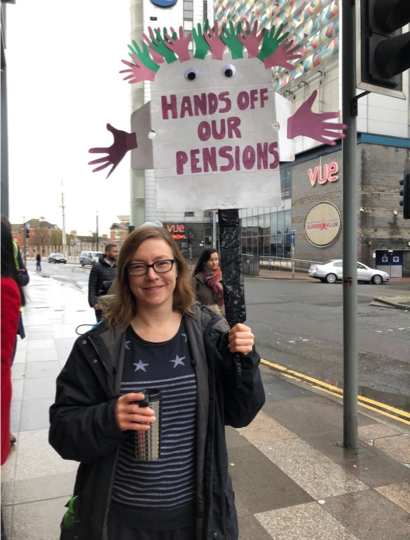
Bio-intimacy in stem cell transplant for acute myeloid leukaemia
Kerry Moore. Introduction by Paul Bowman. Afterword by Karin Wahl-Jorgensen
Introduction
Paul Bowman
My dear colleague and friend, Dr Kerry Moore, died Friday 5th April 2024, after a long battle with leukaemia. We had been hoping to work together on a conference planned for September 2024, called ‘The Future of Intimacy’. The idea was that I would do the early work, but that she would be coming through treatment and into recovery and we would both be working together as the conference approached. However, this was not to be.
The day after we learned that Kerry had died, our friend Karin sent this message to our WhatsApp group:
Paul (and other colleagues) Kerry drafted a talk for the Intimacy conference you were organising, about her experience as a cancer patient and specifically about being the recipient of a transplant. She sent it to me after the last time I saw her (a week ago). I can share with you now if you want to write something about Kerry? I think others may also want to read it. It’s very heartbreaking but also genuinely her voice and I think she would have liked for it to be read by colleagues – as well as maybe more widely.
I thought I would never be ready to read this piece, but I read it the same day. Quite unexpectedly, it did not further break my heart. Rather, it warmed it; perhaps even started to heal it. Perhaps. For, I could hear Kerry’s voice. I could hear her saying the words. And I knew straight away not only that it should be published, but where it should be published – in the most human, caring, intimate journal I know: Capacious. I immediately emailed Greg Seigworth, and he too immediately knew that this felt right. So here we are.
What follows is the draft paper that Kerry was working on for ‘The Future of Intimacy’ conference, called ‘Bio-intimacy in stem cell transplant for AML [acute myeloid leukaemia]’.
But first let me say a tiny bit about Kerry. She was born in 1978 in Carshalton, and grew up in Sutton. She studied at the universities of Wales (BA), Sunderland (MA) and Cardiff (PhD), gaining her PhD in 2010, with a study focused on ways of challenging racism from the left. This topic defined her scholarly interests and personal commitments. Kerry joined the School of Journalism, Media and Culture at Cardiff University in 2006, and went on to teach modules on Media Power & Society, Media, Racism and Conflict, and Doing Media Research, always with a focus on anti-racism, anti-xenophobia and social justice.
Her research explored media and political discourses surrounding migration, racism and social injustice. She published extensively in these areas, including the co-edited book Migrations and the Media with Bernhard Gross and Terry Threadgold (2012) and a special issue of JOMEC Journal, ‘the Meaning of Migration’ (2015).
Kerry published work on European press coverage of the migration crisis in the Mediterranean, immigration politics, populism and Brexit, human rights in refugee news and constructions of racism in UK crime news. She led a collaborative project with journalists and third sector communications professionals in Wales exploring contemporary news media narratives on poverty in the English and Welsh language news media.
She taught, researched, supervised and collaborated on projects that examined racism and racialised crisis discourse, asylum and migration, representations of religious and cultural difference, poverty and social injustice, and discourse theory and analysis.
Kerry was deeply loved by all around her. She was regarded as an excellent colleague and dear friend. She was fanatical about football, and played for Cyncoed Ladies FC. She leaves behind her a husband, Neil, and son, Sascha, as well as a deeply admirable body of scholarly work, and many colleagues and former students whose lives were enriched by her. She is sorely missed.
I knew Kerry since 2003. She was a new PhD student at Roehampton University when I applied for a job there. She attended my interview presentation, and afterwards, kindly said it was good (even though, really, it had been a bit of a shambles). After I got the job, she was a teaching assistant on the big first year module I led.
She later transferred to Cardiff University, after gaining a research assistant position. When I saw a job advertised there, in late 2007, it was Kerry I turned to, to ask about it. She raved about Cardiff and the School of Journalism, Media and Culture (JOMEC), and encouraged me to apply.
When I started at Cardiff University in 2008, I took up supervision of her PhD, along with Professor Terry Threadgold. She was an excellent PhD student. She was my first PhD student in Cardiff, and my first ever PhD student to graduate. To my mind, she should have graduated a year earlier. But she was a perfectionist. For the last twelve months of her PhD, I spent so much time assuring her that she had effectively finished it, that it was really good, that it was ready to be submitted, right now, and that she should just submit it as it stood. But she wouldn’t. She kept polishing and polishing, editing, moving chunks of it around, revising, tweaking, polishing, adding, subtracting, and finessing, until – eventually – it was up to her high standards. Then she submitted it. When it was really brilliant.
I was delighted when she became a colleague, gaining a lectureship in JOMEC. She was just the best person to work with. She was so switched on, so intuitive, thoughtful, circumspect, incisive, diplomatic.
And funny. She would always say something funny. But it was never just funny. It also nailed the crux of the matter. It was wit, yes, and it was always delightful – often muttered quietly to you under her breath during a meeting, as if she were saying something a bit irreverent or subversive, as if she was merely trying to make you laugh. Yet it was actually very often the most concise and definitive statement of the stakes and complexities of the matter.
In a sense, she was like this in many ways. She had a way of seeming mischievous while yet saying and doing things that were utterly responsible, deeply perceptive, highly ethical. She would often seem to be suggesting something naughty – like another drink, another bar, or what about karaoke. But her suggestions were actually, really, the absolute best thing to do – sociable, inclusive, hospitable. It was Kerry’s interventions that produced some of the most fun nights out I have ever had with work colleagues.
Even when she couldn’t go out for a drink, because she had football practice, she would still go out for a drink. And still go to football practice. She wouldn’t let anyone down.
To meet her in the corridor, or stick your head around her office door, or to have her stick her head around your office door, was always like a little treat. Always a gentle word, often a joke. And she would listen, and really, properly, thoroughly, hear. She let me offload about my own parenting problems so many times, and I always felt better. One time, I remember clearly, as we passed on the stairs, we shared the usual light-hearted ‘hello’, but she stopped me, looked me straight in the eye and said, arrestingly, ‘Paul. Are you alright?’ She knew I wasn’t. She knew that, right then, I was far from alright. And she dropped what she was doing, and wanted to help me.
And students loved her. And colleagues loved her. And her work was brilliant. And her concerns were always ethical, always current, always urgent. She researched poverty, migration, exclusion. She published the first bi-lingual (English and Welsh) open access monograph for Cardiff University Press. She was an excellent PhD supervisor. She was extremely talented, diligent, engaged, and always fun to work with. She organised conferences. She edited journals. And she did it all with such good grace and thoroughness and clear-sightedness and collegiality.
When she got ill, we all thought she would beat it. She was so fit and so strong and so determined. And it would just be so wrong for there to be any other outcome. Even when she was going through the most difficult treatment, she wanted to join in and help me organise a conference. We’d chat about it over WhatsApp, and I’d keep her informed about developments. And she was looking forward to it – she was working towards it. And, God, so was I – looking forward to working with her again, bumping into her in corridors, asking her opinion or advice, chatting about family or holidays or the government or the institution, or anything, everything.
But, tragically, that is not to be. And it breaks my heart. We are bereft without her. And we will all miss her so much, for so long. There is no adequate way to say goodbye, Kerry, you were the best colleague, the best friend, and we all love you. But publishing this rough, unfinished piece, in this hospitable, caring and intimate journal, is at least… something.
What follows has been ever so slightly tidied up by me and the editorial team at Capacious. We have tried to keep this to an absolute minimum. But the work was, and will always remain, an incomplete draft. It was not written in any journal style, and was meant to be spoken, at a conference on the future of intimacy. So I have had to make some slight interventions into the text – proofing, tidying, adding, here and there. I have added some footnotes to clarify a few points, adding ‘[PB]’ at the end, so you know they are my words, not Kerry’s. Nonetheless, what I think shines through is Kerry’s wonderful mind, wonderful style of thinking, and – something I will always cherish, and deeply, deeply miss – her voice.
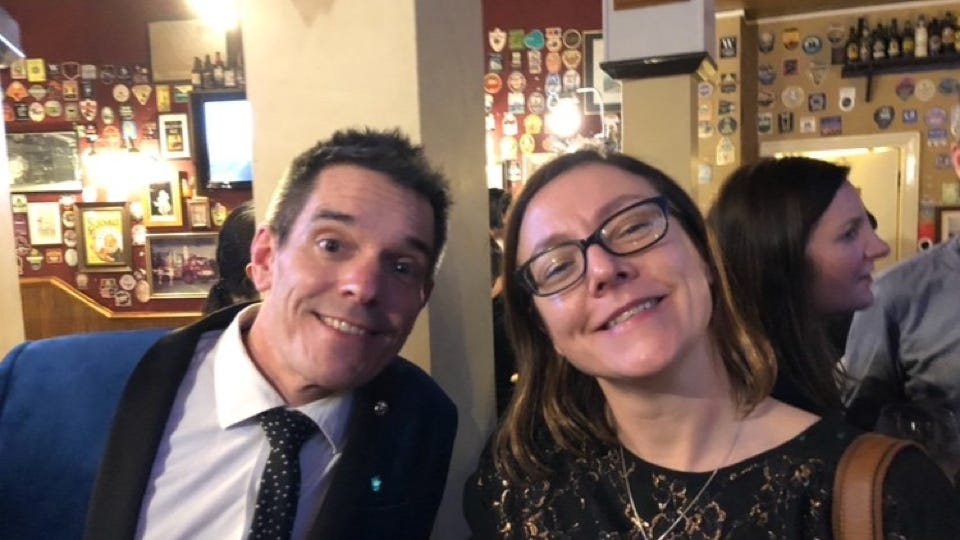
Bio-intimacy in stem cell transplant for AML
Dr Kerry Moore, Cardiff University (last updated 7th Feb 2024)
For The Future of Intimacy Conference, Cardiff School of Journalism, Media and Culture. September, 2024[1]
‘Loving you is in my DNA, loving you is the only way’
Billy Gillies featuring Hannah Boleyn - DNA (Loving You)
Released 28th July 2023 (7 days post transplant)
My Intimacy Story
29th November 2022 –
On 29th November 2022 the future of every relationship in my life was suddenly and devastatingly transformed. I was a (normally) healthy, very sporty, crap car owning, converse wearing, typical academic in my mid-40s. But after a couple of weeks of, what I imagined was an incredibly grotty bout of flu, I was diagnosed with Acute Myeloid Leukaemia (AML) with a FLT3 mutation.
If you read the start of almost any peer reviewed article about AML with a FLT3 mutation, it will emphasise the ‘dismal outcomes’ for patients. This dismal outlook, experts assure us, remains dismal despite important recent advancements in treating LK and other blood cancers. It’s especially fun to read that as a patient who is surreptitiously perusing the peer reviewed academic literature! The well-REF-trained[2] among us will know flagging ‘big problems’ in the intro is rhetorically handy for impressing readers with our ‘groundbreaking’ results and solutions, but also, unfortunately it’s true.
Fast-forward 13* months, various chemo, radiotherapy treatments and a stem cell transplant, and despite my blood cancer journey not exactly being over, evidently I’m still here (hooray!)* thanks to incredible science and an equally incredible medical team.
So, what has all of this to do with intimacy?
Actually, quite a lot in some quite different ways:
• I could talk about the professional and yet intimate relationships developed over the past year with my incredible medical team.
• I could talk about the crucial loving and life-sustaining relationships with family and friends for my survival; the collective-intimacy hugging me through it all.
• I could talk about the most awesome wedding proposal and loving marriage after 15 years of groovy co-habitation.
• But what I actually want to talk about today is the idea of bio-intimacy.
Bio-intimacy
My interest in this idea preceded any awareness of the concept.
I’ve already mentioned that I had a stem cell transplant last summer. Essentially, this entailed cells harvested from the bone marrow of an unrelated allogeneic donor – another human who matches me genetically – being infused into my body.
The intention of a stem cell transplant is to introduce a new biological process into the body, where infused donor cells ‘engraft’ in the recipient and begin to do the work of a healthy bone marrow. The ‘graft’ will produce fully functioning white and red blood cells, recognising any potential remnants of diseased bone marrow and blood cells – creating a shiny new, healthy immune system.
What could be more physically ‘intimate’ than welcoming another human’s body parts into your own (ooh er![3])?
Perhaps one of the more surprising features of this experience of bio-intimacy is its foregrounding of conflict. Like any medical transplant (and I guess like any relationship), although ‘happily ever after’ is the goal, rejection is a possibility. For stem cell transplants, the road to rejection (or acceptance) entails a gladiatorial battle between donor and recipient (new me and old). My heart’s desire is for ‘other’ to ‘become me’ (is that Nietzschean?).
Unfortunately, regardless of my ambitions or feelings (or those of the donor for that matter), what will actually happen once the horse has been led to water cannot be entirely controlled, and some level of fighting is, biologically, almost inevitable.
If the donor arrives like a furious toddler shouting ‘this isn’t me!’, the recipient can be attacked and damaged in unintended ways – even mortally wounded (this is what we call Graft Versus Host disease). There are immune suppressing medicines that are used to control this risk.
Alternatively, the host can be the dominant antagonist, refusing hospitality, spreading its sharp elbows, beating back the newcomer from her would-be new home. Let’s call it a ‘gammony’,[4] ‘Brexity’ short-sightedness placing short term political gain above the obvious benefits and long-time survival of the mothership. To labour the metaphor slightly, this ‘Farage-ification’ of my bone marrow is unfortunately what happened to me in Dec-Jan 23-4.
‘New forms of embodied intimacy’ (Sharp, 2006): Feelings[5]
Whilst the science, the ‘bio’ part of bio-intimacy is obviously at the centre of the action, the emotional arena is both conditioning of and conditioned by the experience of this relationship between self and other; the sharing, lending and ‘melding’ of bodies or body parts mediating between life and death.
**cultural explorations - e.g., Hanif Kureishi, films like Dirty Pretty Things, distopian sci-fi, Mary Shelley’s Frankenstein - exploring scientific ethics with new possibilities, exploitation, forced organ harvesting; consent/pros/cons **[6]
There is some fascinating literature about other bio-intimate relationships in organ transplantation and the donation, sharing or sale of other human bodily products, covering their social, economic, regulatory, moral and political implications and contexts, for example:
· The donation of breast milk
· Sperm and egg donation for artificial insemination in human reproduction
· Surrogacy
· Blood donation
· Organ and other body part transplantation – including living donors (kidneys) and posthumous donations (hearts, livers, lungs etc).
There is not much in the academic literature about bio-intimacy in the context of stem cell transplantation.
Each of these areas have their own important power dynamics, their own particular attendant ‘issues’ and debates.
They have their own iterations of individuality in human relationships, proximity and distance between donor and recipient, donor and wider friends/family. Their own private and public expressions of emotion, their own structures of feeling.[7]
All however, share a fundamental dynamic – the necessity of the bodily, biological assistance of others for life – for survival, sustenance or conception.
**I’d like to further explore those life stories (mostly, if I’m honest, my own future bio-intimacy stories – ideally into my 50s, 60s, 70s and beyond).
· What does bio-intimacy mean in the field of stem cell transplantation? What emotional, moral, social or cultural factors inform the donation of bone marrow, and blood products?
· Do social and cultural factors carry any significance for recipients in this relationship? If so, how?
· What role does individual and/or social psychology play in the bio-intimate dynamics of transplant?
· Do donors and recipients ever strike up relationships?**
**End of exposition/scoping of field/start of auto ethnography section** **endnote - other literature on different types of transplant and biosharing/donation)**
Bio-intimacy and me
**Keywords: Anonymity, Gratitude, indebtedness, Helga, letter writing, loss, mourning…**
How do I feel about the donor (or donations as the things that have sustained my life since November 2022)? Are these disaggregated? Do I love the donor or just her cells?
Since stem cell donation (in the UK at least) is anonymous, the notion of any intimacy playing a role may seem anathema. Yet, for me at least, despite the regulatory and ethical necessities of the distance imposed by anonymity, it has been impossible to separate the biological process from the will towards cognitive/emotional/psychological proximity. What is ‘planted’ in a transplant is far more than bodily cells.
With respect to other types of transplant or biological exchange, fascinating narratives have been documented about the negotiation of distance/proximity and the experiences and (sometimes) circumvention of institutional barriers or regulatory safeguards.
For bone marrow/stem cell transplants, there are ‘backroom’ facilities for recipients to contact donors which are carefully mediated and regulated. However, I am not aware of any ‘real-life’ face to face human interactions between donors and recipients. In this space, instead, are imaginative possibilities: for making sense of the medical beyond understanding its objective, scientific aims, processes and outcomes – the emotional and psychological events attendant to each stage; and, perhaps more tentatively, the creation of imaginative narratives that ‘close the gap’ connecting the emotional/cultural and psychological worlds of recipient to their donor.
How does imagination play a role in anonymous donor-recipient relationships? Are there good/bad helpful/unhelpful ways to imagine them? What would be the measures/rationales for such judgments?
Intimacy ‘imagined and enacted’
Helga (derived from Old Norse heilagr - “holy”, “blessed”)
(Wikipedia, 2024) lol.
The only information I had about my donor (beyond crucial genetic facts about them that made them ‘a match’) was that they are a female, over 30 and from Germany. Although a career of challenging social and cultural stereotypes made it slightly uncomfortable, the will to name my donor based on this scant information was irrefutable, and ‘Helga’ she became.
Words cannot express how grateful I feel towards Helga for her cells. It is an overwhelming, emotionally incomputable fact that someone – and someone I’d never met, at that – donated part of their living body for the purpose of my body surviving. I know nothing of my donor’s motivations, but whatever they were (or are), they voluntarily put themselves through a procedure which led to their DNA being shared with me.
The naming was part of the process of imaginatively enacting the intimacy that was being enacted biologically at a cellular level. Lol @ the not quite Suzie Dent[8] quality of research, but the name as it turns out was strangely appropriate, meaning ‘holy’ or ‘blessed’, so Wikipedia informs me. My faith was, and is, entirely invested in the science, but if any other teams were quietly lining my ranks ready for battle, they were gloriously welcome.
Self at stake
Early in the disease I certainly went through feeling that my body (or at least my bone marrow) had ‘betrayed’ me, as Bipin Savani puts it in his book on the complications and management of blood and marrow transplantation.[9] My immune system – designed to protect my life up to then, had randomly stopped doing so. Complex mutations at a genetic level were busting out useless immature zombie white blood cells, switching off the safeguards that normally tell these to self-destruct and smothering any productive blood the stem cells were still trying to produce. Sneaky shitty little back stabbing saboteurs.
Since diagnosis, I’ve watched a lot of Silent Witness, which until recently I thought was probably weird for someone facing their mortality. But, come to think of it, it was always about my desire to scientifically investigate under the skin, to see through the bodily exterior and reveal the evidence of what exactly was happening inside me. It nicely dramatizes my fantasy of cleverly identifying the mutinous internal culprits, and bringing them to justice (well actually, bloody well pulverising the blighters).
Miraculously, after much trouble, my haematology doctors tamed my disease into remission in early-mid-summer 2023, found me a donor when that seemed unlikely, and a stem cell transplant was now ON.[10]
No question: if there was going to be a fight between ‘old me’ and ‘Helga me’, I had no hesitation – 100% ich heiße Helga.
Je suis Helga
For two months, I almost ‘became’ Helga. The transplant ‘engrafted’ and in a month my bone marrow was approximately 95% full of her. I loved this. I loved this new DNA me with new prospects of survival. I would put my body through anything to solidify this intimate relationship, for ‘other’ to subsume ‘self’. I wish I could say we were inseparable. But inside, despite ‘old me’ bone marrow having been blasted to kingdom come by total body irradiation (TBI) and intensive chemotherapy, my unreliable, treacherously Leukaemia-unobservant stem cells were already agitating for a comeback.
Internal conflict ensued, initially carefully managed with immune suppressing meds to avoid graft versus host disease (GVHD) (i.e., to prevent Helga running riot on my body/her new body in life threatening ways). We seemed to be antagonistically co-existing as planned, with fingers and toes crossed hoping Helga would get her fisty cuffs out, deal a knockout blow to the 5% treacherous ‘old me’ (GVLE – Graft versus Leukaemia effect), and live happily ever after.
Instead, by early January 2024, I was replaying this story mournfully in my dreams, weeping over Helga’s lost fight and its twists and turns as my medical team sought to rescue me/her. Like a temporary Facebook profile pic, Helga’s DNA, had been intensely everywhere and everything to me. We’d had a go, all-in on bodily hospitality and solidarity, but the bad old boys were back on the block with their biological weapons, ready to recolonise my marrow-verse. Helga-self was slipping away.
Of course, I’ll still support Germany in the football in ways I never would have thought before… And obviously when I say Germany, I should say I’m thinking about Alexandra Popp’s incredible headed goals… although viel Glück to the men too.
Last chance saloon…
So, here I am in the last chance saloon. So far it’s not my favourite type of saloon. Less like the City Arms than a bare knuckle fight at the top end of St Mary’s Street,[11] with ambulances primed for the blood we must expect will be spilled – hoping for the best, preparing for the worst.
It’s the only saloon in town now, so I’d better be ready to take my chances. If I’m lucky, science may save me. Maybe we can talk about my Helga again – or maybe another ‘other-self’, should my perfect match for a second bio-intimate transplant adventure suddenly appear, riding across the sunset planes of the stem cell donor bank database. (**find out name).
Bio-intimacy autoethnography – just a sorrowful/tragic/heroic story all about me!?
I’m aware that a very self-indulgent monologue at a conference that wouldn’t deny me an audience is probably ethically living on the edge. It’s been undeniably cathartic to write and to imagine relating to you. Nonetheless, I hope there is also academic value in it.
I’m also cautious about assuming testimony in ethnographic studies to be a necessarily liberating thing. Similarly, to give one’s story to media to publicise a cause is not necessarily a useful, good or empowering thing for the source themselves. Lots of important stuff is written about those things.
However, on balance, we love a good story, don’t we? Most of us are nosy and most of us love a bit of attention!
Seriously though, one of the things I’m trying to do with this is to explore and maybe expand upon the cultural value of the field of transplant ethnographies. For our purposes, I’m interested in the particular insights my story may bring to bear on understanding, what Sharp (2006) calls ’new forms of embodied intimacy’ with transplant.
…
Other updates may be possible. Could be same or different donor.
Conference cancelled but could still be a paper delivered in a different context or something written up by me or someone else interested if necessary.
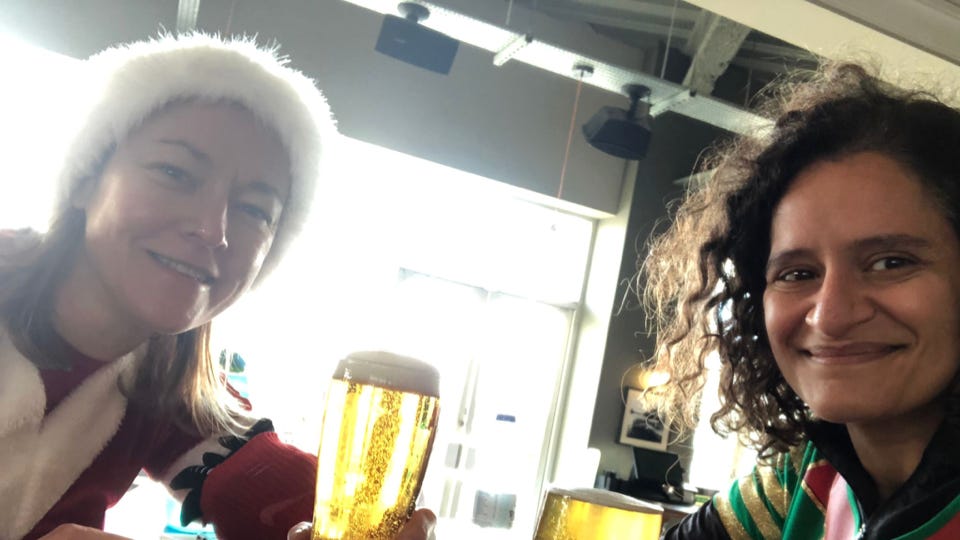
Afterword
Karin Wahl-Jorgensen, Cardiff University
I write this as a colleague and a friend of Kerry. As colleagues, we shared an interest in issues of media and democracy, and I always found much to admire in her sharp observations about political life, her clear and insightful writing, her care and support for her students, and above all in her unwavering her commitment to social justice that shone through everything she did.
However, our close friendship came out of a very different kind of collaboration: Over the course of more than a decade, starting in 2011, we baked together every few months. We started baking together after an incidental chat in which we discovered that we both always wanted to know how to bake, but considered ourselves lost causes, having somehow arrived into adulthood bereft of baking skills. We named ourselves “The Novice Bakers” to manage expectations of anyone who dared to eat our creations.
We started in 2011 with Danish vanilla ring biscuits and strawberry layer cake, and the last time we baked together was on December 20, 2023, when we baked sunken olive oil, chocolate and hazelnut cake.
At Kerry’s urging, there was often a seasonal theme – making soaked fruit puddings in the summer, warm desserts and savoury pies in winter. There were different phases to our baking.. There was the political phase, where we did every Palestinian recipe we could get our hands on. There was the red wine phase, where we prioritised simple bakes to optimise wine consumption. And there was the extended cupcake phase, where we did red velvet cupcakes with far much too red food colouring, Halloween cupcakes with spider webs in icing sugar (Kerry was always the decorating expert), and the unfortunate incident with the green tea cupcakes where we used a particularly potent green tea powder which made it taste more like freshly cut grass than tea
Over time, however, we actually learned to bake and although we continued to call ourselves novices we became more or less competent. Kerry ultimately branched out into a great solo baking career, with her creative pizza faces a particular highlight, featuring everyone from Chris Whitty to Donald Trump. We both passed our love of baking onto our children, who were always excited about our baking nights, while our partners sometimes endured but mostly enjoyed the fruits of our endeavours. We baked through major life events, social changes and historical crises. We talked about everything in our lives and beyond, and became very close friends.
In the last year and a half, when Kerry so often had to assess the risks of social interaction, we swapped the baking for nature walks or socially distanced visits.
When infections landed her in hospital, I visited her there. While Kerry shared with me the details of medical treatments, diagnostic news, loud hospital wardmates, and comic vegetarian meal choices (plain mashed potatoes with plain pasta and peas, if you’re interested), it wasn’t a one-sided conversation. Instead, Kerry always took the time to ask how I was, and to listen. When I voiced my reluctance to share my mundane woes (including, but by no means limited to, a stubbed toe, a difficult teenager, and my appalling record of caring for house plans), she insisted that these conversations were meaningful to her precisely because of their mundanity, which took her away from the hospital ward and out into the world outside which she so longed for. So I continued to tell her everything, and she was always there for it.
During her illness, she approached the terrifying and crappy odds she had been dealt with such strength, grace, self-awareness and presence. Yes, she did talk a lot about how shit it was and rightly so. But she was clear-eyed, funny and pragmatic about it as well. Her greatest concern was not for herself, but for her son, Sascha and her partner, then husband, Neil. She desperately wanted to live and was ready to do whatever that took, but also very open about the terrible cards she had been handed.
Just under two weeks before she passed away, Kerry had an emergency tracheostomy, due to the infection which ultimately took her life. She asked for me to come and see her in hospital on Easter Friday 2024. While I had regularly made the journey to the various wards in Cardiff’s Heath Hospital where she spent much of her last few months, this was different: She was in an isolated room in the Hematology ward, and I was required to put on an apron, gloves and mask before entering the room. Kerry had warned me that she couldn’t speak, only write. Once I was in the room with her, she waved and smiled, then scribbled away – pages and pages of her neat handwriting on a pad in response to my spoken word. I stayed with her for over an hour, the pages on the pad filling up in response to my questions, and because there were things she wanted to tell me. The pad allowed her to be as expressive and present as ever. However, I did notice the sound of silence – as an absence of her warm laughter. One of the last things she wrote before I departed was that she wanted to send me the intimacy thing she’d been working on.
Kerry wrote this piece during the last year of her life – from the time of her organ donation, in June 2023, and until she got too unwell to carry out further revisions, in February 2024. We frequently discussed the ideas animating the piece, and the process of writing it. When she first aired the idea, the notion of bio-intimacy seemed to me both strikingly original and very Kerry. It’s very Kerry because it reflects a particular way of reading and reflecting on established concepts against the grain, based on rigorous theoretical engagement, yes, but also common sense and hilarious yet insightful metaphors.
Like Paul (as noted in his introduction), I was initially reluctant to read the piece, but when I did, I found comfort, profound insights and lots of laughs. I found Kerry’s voice. The piece represents her grappling with some of the most profound and paradoxical questions imaginable: What does it mean to invite an alien immune system to take over our own? How should we understand this new “emotional arena,” which “is both conditioning of and conditioned by the experience of this relationship between self and other; the sharing, lending and ‘melding’ of bodies or body parts mediating between life and death”? What are the novel structures of feeling – including new forms of embodied intimacy – generated by the bionic possibilities of the stem cell transplant and the encounters it occasions? As a scholar of emotion and media, the conceptual landscape is a familiar one to me – I have spent years immersed in reading and writing around the sociology of emotion, invoking structures of feeling, intimacy and solidarity. Yet the ways in which she engages with these concepts – through her own life-and-death embodied experience – are entirely fresh. Reading the piece made me reassess these fundamental ideas, which look and feel so different seen through an existential encounter in the body of a loved one – in this case my dear friend Kerry.
For Kerry, the encounter was with the stem cells of an imagined alien and ally, a stout and strong German woman named Helga. Although the transplant initially showed strong prospects of success, Kerry’s “unreliable, treacherously Leukaemia-unobservant stem cells were already agitating for a comeback” and ultimately rejected the welcome invader.
Kerry reacted to this news with her brand of clear-eyed appraisal and wry humour, with a sprinkling of much-needed hope where others might see only despair. While she was desperately sad about the grim prospects, she also remained open to any and all possibilities, no matter how harrowing: “So, here I am in the last chance saloon. So far it’s not my favourite type of saloon. Less like the City Arms than a bare knuckle fight at the top end of St Mary’s Street, with ambulances primed for the blood we must expect will be spilled – hoping for the best, preparing for the worst. It’s the only saloon in town now, so I’d better be ready to take my chances.” Reading these lines, I can hear how Kerry would have read them, and I can see her standing at the podium, a devious smile on her face and a glint in her eye.
As I’m writing this, the 2024 Euros are underway and Germany’s still in the mix. I’m here in Cardiff, and I’m cheering for Germany and for Helga, and wishing that Kerry was here watching it with me.
[1] NB: This conference was cancelled [PB].
[2] The REF, or ‘Research Excellence Framework’, is the UK’s academic census of research outputs. It determines the status of institutions and – crucially – the amount of research funding provided to different universities. As such, it is something high on the agenda of research intensive universities in the UK [PB].
[3] ‘Ooh-er!’ is a British exclamation that draws attention to a sexual inuendo or double entendre. It was popularised (and quite possibly invented) by the late British comic actors Rik Mayall and Ade Edmonson, especially in the 1980s comedy sit-coms Bottom and Filthy, Rich and Catflap.
[4] Gammon and gammony are used to describe a (normally rich or upper-class) right-wing British person – such as Nigel Farage (mentioned below), who was prominent in the campaign for Britain to leave the European Union (aka ‘Brexit’) [PB].
[5] This subtitle seems to be evoking Strange Harvest: Organ Transplants, Denatured Bodies, and the Transformed Self, by Lesley A. Sharp (University of California Press, 2006) [PB]
[6] These are most likely points Kerry was considering including or developing [PB].
[7] Kerry added two asterisks after this sentence, which seems to be her way of noting that she either wanted to add a reference later – most likely to Raymond Williams’ chapter ‘Structures of Feeling’ in Marxism and Literature – or perhaps that she wanted to say a little more about this point, as elsewhere two asterisks seem to indicate is a point to be developed or discussed further [PB].
[8] Suzie Dent is a lexicographer and etymologist who appears in this capacity on British TV game-shows and comedy panel shows [PB].
[9] Most likely Bipin Savani, Fast Facts: Leukemia: From initial gene mutation to survivorship support (S. Karger, 2019), which is available for free download in the UK on Amazon Kindle [PB].
[10] Kerry adds a footnote here, which reads: ‘lots more to this, too detailed to say, but maybe document case history further here’.
[11] The City Arms is perhaps Cardiff’s oldest continuously open pub, one that Kerry would often visit with her colleagues from work or football. St. Mary’s Street is a main street in Cardiff, running up to the main entrance of Cardiff Castle [PB].

Comments
Post a Comment