YouTube’s Noble Savages: Functional Fitness, Circular Strength, and Myths of Another World on Social Media
… all the sexual, psychic, somatic recycling institutes, which proliferate in California, belong to the same order. People no longer look at each other, but there are institutes for that. They no longer touch each other, but there is contactotherapy. They no longer walk, but they go jogging ... Everywhere one recycles lost faculties, or lost bodies, or lost sociality, or the lost taste for food. One reinvents penury, asceticism, vanished savage naturalness: natural food, health food, yoga.
Jean Baudrillard, Simulacra and Simulation
Separation Perfected
‘Functional fitness’ is an umbrella term for a cluster of approaches to exercise that combine the simultaneous training of strength, stamina, cardiovascular fitness, explosive power, and movement, mobility and athleticism. Its most committed practitioners often engage in competitions that test almost every currently recognised definition and category of ‘fitness’. But it is also pitched as a non-competitive (or purely self-competitive) approach to exercise that can improve anyone’s quality of life, even those who only dabble – by improving their mobility, balance, strength and stamina. A phrase commonly used to explain what functional fitness seeks to develop is ‘general physical preparedness’ (GPP). There are many schools, tools, styles and approaches to functional fitness, including such as well-known entities as CrossFit, Hyrox, TRX, and kettlebelling. There are also more marginal ones, such as training with heavy steel clubs – which will be my main focus here.
The central concept of the movement – ‘functional fitness’ – is actually a disputed and contested term. There is no univocal scientific consensus about what ‘functional’ or indeed ‘fitness’ might best be taken to mean (Spatz 2015). But proponents share a common disdain for exercises that isolate muscle groups (the biceps curl is the most commonly used example), or that preclude the athletic/kinetic combination of different elements (activating the ‘posterior chain’ is often invoked as a key virtue). What this means is that, while well-known gym movements such as the bench press, for example, certainly involve several major muscle groups (pectorals, deltoids, triceps), those groups are isolated from any significant dynamic connection with the rest of the body. This means that total body movement is precluded. Furthermore, when bench pressing with heavy weights, you cannot introduce variation, because raising and lowering a heavily weighted bar requires attempting to maintain a fixed and stable line of movement. Hence, even well-known and well-respected exercise staples such as the bench press are not favoured in the functional fitness world.
Since the mainstreaming of modern bodybuilding since the 1970s, along with the expansion of mass-produced commercial exercise machines since the 1980s, the fitness industry and fitness culture have refined the art of isolation and separation. Today, most gymgoers would be able to make a clear distinction between cardiovascular training and hypertrophy or strength training. Many will know the slightly more refined difference between hypertrophy training and strength training. And a fair proportion will even be able to make clear distinctions between such matters as different ‘zones’ of cardiovascular training, or finely graded and nuanced distinctions between how to work the upper pectorals versus the front deltoids, how to target the different muscles in the calves, or the brachialis versus the biceps, and so on.
In reaction to this, the functional fitness movement of the twenty first century rejected separation and focuses on the value of functionality. It declares: who really cares whether you are exercising your front deltoid or your upper pectoral, when what is much more likely to matter ‘in the real world’ is whether you can complete a demanding physical task that might well involve pushing away very hard at unpredictable and changing angles for a long time while in awkward positions or on uneven surfaces? Functional fitness values general physical preparedness and distances itself from the culture of the image that has arguably dominated exercise culture since the advent of Hollywood’s spectacular bodies in the 1980s (Tasker 2012; Jeffords 1994). It’s not how you look, it insists, it’s what you can do, in the real world.
In other words, functional fitness is organised around ideas/ideals and values such as functionality, reality, practicality, usefulness, etc. Given this, one question for the cultural analyst is whether its fixation on ‘reality’ means that functional fitness is free from myths? Is it a discourse of truth, free from ideology? Is it really organised by reality, and free from mythology?
Given the breadth and heterogeneity of the functional fitness movement, these are not questions that should be posed ‘in general’, without close references to specific examples. So, I will limit myself to a modest exploration of this question by looking at some select examples of one specific field of functional fitness. This is a branch that focuses on what is called ‘circular strength’ training. Circular strength training takes the form of swinging tools such as heavy clubs, maces, and kettlebells, particularly in what proponents like to refer to as ‘throwing patterns’ and other ‘functional patterns’. This field of practices may seem marginal or niche when compared to how many people know about more mainstream practices likes CrossFit or Hyrox, for instance. However, as circular strength proponents often observe, strength, ‘fitness’ and ability to move fluently, under load, in circular or non-symmetrical planes, is at the heart of sports such as golf, tennis, baseball, American football, and innumerable other movements of everyday life. Indeed, they add, many ‘mainstream’ functional fitness styles actually miss, ignore, or underplay the importance of ‘circular’ movements in sport and everyday life. Thus, circular strength proponents sometimes position their approach as being more functional than other approaches to functional fitness. Furthermore, circular training has some noticeable dimensions that are not quite as prominent in other discourses of functional fitness. For instance, its proponents make regular reference not only to ideas about sports (and) science but also, significantly, to non-European traditions and ‘ancient’ practices.
In what follows, I set out some of the structuring features of the output of three well-known proponents of circular strength training. I will explore their approaches specifically in terms of the place of ‘myth’ within them.
Myth as Double Sell
The approach to ‘myth’ I will use derives from the work of Roland Barthes (1957, 1993). Other approaches are available. What Barthes meant by ‘myth’ can be defined, debated or described in all sorts of ways, using all sorts of technical academic terms. However, we can sidestep such complexity by beginning from a key and simple observation that is at the heart of Barthes’ argument about myths. Namely: they involve a double sell. Whether in advertising, poetry, or politics, a myth arises when a vision of the world is pitched, in relation to which a product or project is proposed.
Advertising messages might therefore be boiled down to something like: ‘Hey you! Do you want your life to be like this? Then buy this’. In politics: ‘Hey, the world is like this, so you need us to fix it’. Barthes argued that myths arise in many other kinds of practice too. For instance, he begins his 1957 classic, Mythologies, with a discussion of wrestling. In the old music hall incarnations of wrestling of his day, Barthes argues that it attains the status and does the cultural work of a kind of classical morality play. Much like WWE or lucha libre of today, we see good characters and evil characters. Their bouts are interpreted as battles between good and evil. (Barthes opposes this kind of wrestling to judo, but we might also oppose it to Olympic wrestling, which Barthes would regard as competitive sport rather than pure entertainment spectacle.) Thus, in order to sell us a specific thing (tickets or subscriptions) wrestling forwards a mythic idea of the world, structured by good and evil, and thereby reiterates such values as values.
Similarly, to use another of Barthes’ examples, advertisements for an autumn clothing range might involve images of a pleasant walk through the leaves, with a loved one, or a nuclear family group. Such images offer a vision of an idyllic or ideal kind of life. In one regard, this is simply in order to sell woolly jumpers. But by the same token, it is also ‘selling’ domesticity, heteronormativity, marriage, parenthood, and other conservative social values. Likewise, images of glamourous social worlds populated by beautiful people are used to sell diamond rings. The desire for diamond rings stoked by such adverts reimposes consumerist ideals and ideologies.
Thus, myths involve a ‘double sell’. They propose a mythic image of the world or of reality in order to push a specific product or project. This means that cultural critics need to ask two basic questions. First: what is the vision of the world that is being proposed here? Second: what is it being used to sell? Working out answers to these questions is a fundamental task of cultural criticism.
The Exercise of Ideology
What is being ‘sold’ in images of exercise? In a sense, there are too many possible answers here. Exercise is arguably always a kind of ‘ground zero’ of the meeting of myths and actions – a place where ‘the rubber meets the road’, at the interface of arguments, ideologies, beliefs and embodied praxis. Governments institute physical education curricula for youth to ‘strengthen the nation’. Adults take up sport or exercise in response to messages about why and how they ‘should’ change their lives, look after themselves, improve themselves. All such messages can be regarded as ideological, or at least moral, even when they are supposedly rooted in in science. They emanate from schools, governments, religions, the mass media, percolate through family and friends, and of course they permeate social media.
Even when they are ‘scientific’, messages about exercise always come with heavy ideological clout. As Andrew Barry (2001) argues, ‘facts’ are never neutral or open-ended. Scientific research into any topic is always driven by such matters as ‘concern’. Thus, the establishment of facts about such matters as the risks or values of smoking, drinking, diet or exercise, is from the outset driven by ‘concerns’ that are pre-scientific – social, moral, cultural. Indeed, argues Barry, any scientifically or socially established ‘fact’ about the human world always carries a moral value and hence an imperative or injunction to behave a certain way (Barry 2001).
Exercise is always a double sell: Because the world is like this, it requires this; thus you must exercise like this.
In what follows, I take a whistlestop tour of a few interlocking islands of today’s ‘reality focused’ functional fitness archipelago, in order to identify and unpack just a few of the many myths that are used both to sell an image of a functional you in a functional society and, of course, to sell specific things. The things in question are nothing more sinister than some curious pieces of exercise equipment (heavy baseball bat style clubs made of steel, and heavy wooden or steel maces), and, of course, all the classes, courses and lessons that focus on how to use these implements to best effect – the best effect being, of course, to change you. The myths which package and transport the selling of these physical and virtual/pedagogical products operate on two fronts at the same time. First, we are told: These things will change your life; follow me and I will show you the way. But, at the same time: these things are not simply a gateway to a new and improved you; they are also a portal back to lost mythic golden age – a lost age of truly functional people.
Flow Shala
Flow Shala is a movement-coaching brand and studio centred on strength, mobility, yoga-informed training, and holistic wellness. Its primary online presence takes the form of the social media output of its founder and figurehead, Summer Huntington. Huntington describes her background as combining kinesiology, yoga training, movement performance coaching, and the development of her unique exercise and movement systems such as ‘Steel Mace Vinyasa’ and ‘Clubbell Yoga’. As their names imply, these systems combine styles of yoga with weighted training tools: the steel mace (a bar with a round weight on one end) and ‘clubbells’ (baseball bat-shaped clubs of various weights, normally made of steel). Huntington presents Flow Shala as a ‘house of flow’ (shala being a Sanskrit word meaning ‘home’), that helps people build an ‘intentional movement’, with a strong emphasis on flow state, kinesiology, and behavioural change (Flow Shala, n.d.).
On 5th May 2026, Huntington posted a video on YouTube, filmed during a bi-annual Flow Shala retreat in Bali. If we were on the lookout for a double-sell, we could easily see two here: the clip is most literally a ‘how to’ – a free pedagogical mini-lesson, in the well-worn genre of the ‘YouTube instructional’. But is also, of course, an advert for future retreats. But this is not the myth – this is just the advert. There is more.
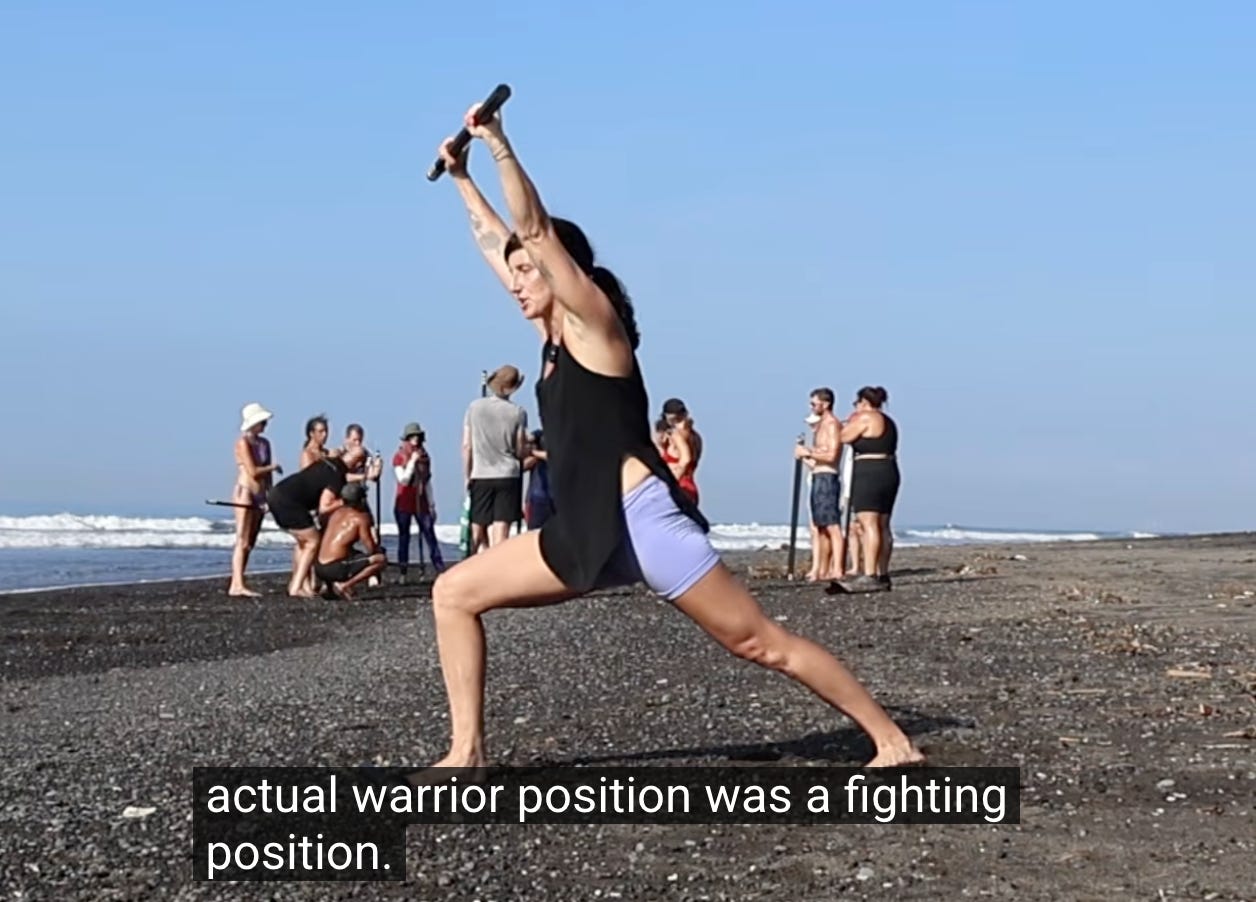
In the video, the topic is how and why to execute the yoga pose (or asana), ‘Warrior One’ (Virabhadrasana I) with a steel mace (Huntington 2026). The video is filmed on a beach. In the background, we see a group of 15–20 people taking instruction and practicing blocking and striking movements in pairs. Huntington mentions that their coach is Mark Wildman, a well-known movement and exercise coach with a large social media following, who specialises in promoting steel club, mace, and kettlebell training. (We will discuss Wildman soon.)
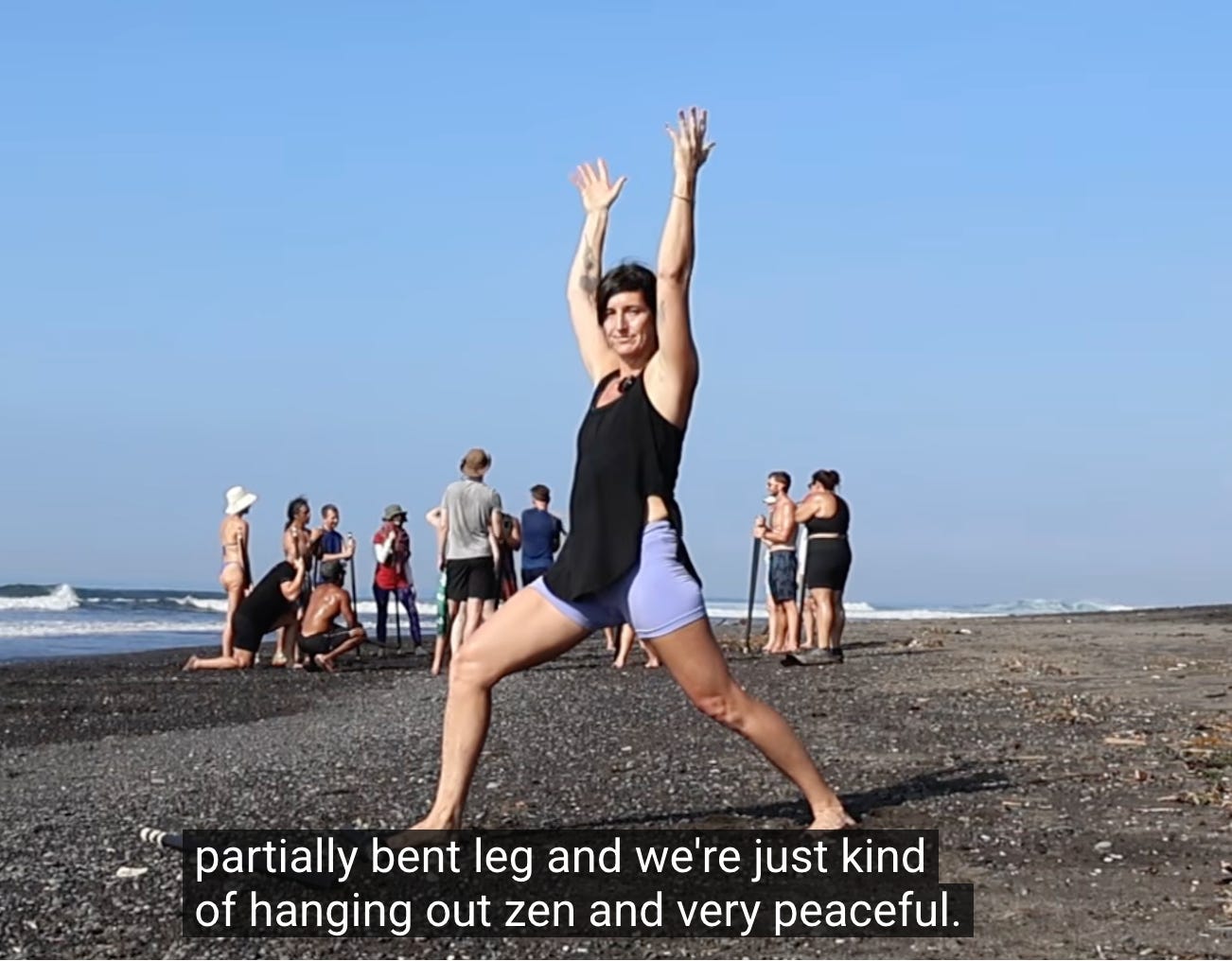
After introducing Warrior One as it is normally done in yoga practice, 40 seconds into the video Huntington says:
But you want to know that there is an actual reason for Warrior One. So, in most yoga classes, a Warrior One is kind of a partially bent leg and we’re just kind of hanging out Zen and very peaceful. In the origins of warrior training, the actual warrior position was a fighting position. It was, it was a defence drill or a defence position. Warrior Two was going from Warrior One, switching, changing directions – Warrior One on the opposite side: Warrior One block, Warrior One block. Right? And so, when you return back to the actual origins of warrior training, striking patterns, blocking patterns, Warrior One patterns, centre of gravity, low to the ground, you start to tap into a different ancestral memory that predates language [and] lives in your lizard brain. You’ll see as our athletes start moving and training. Mark’s doing a little breakdown right now, but you’ll start to see that people naturally and intuitively know how to get into a Warrior One. Let’s check it out with a 7lb steel mace. So, we start in a reverse guard position. Knee bend. Same side leg step back here in a block here. (Huntington 2026)
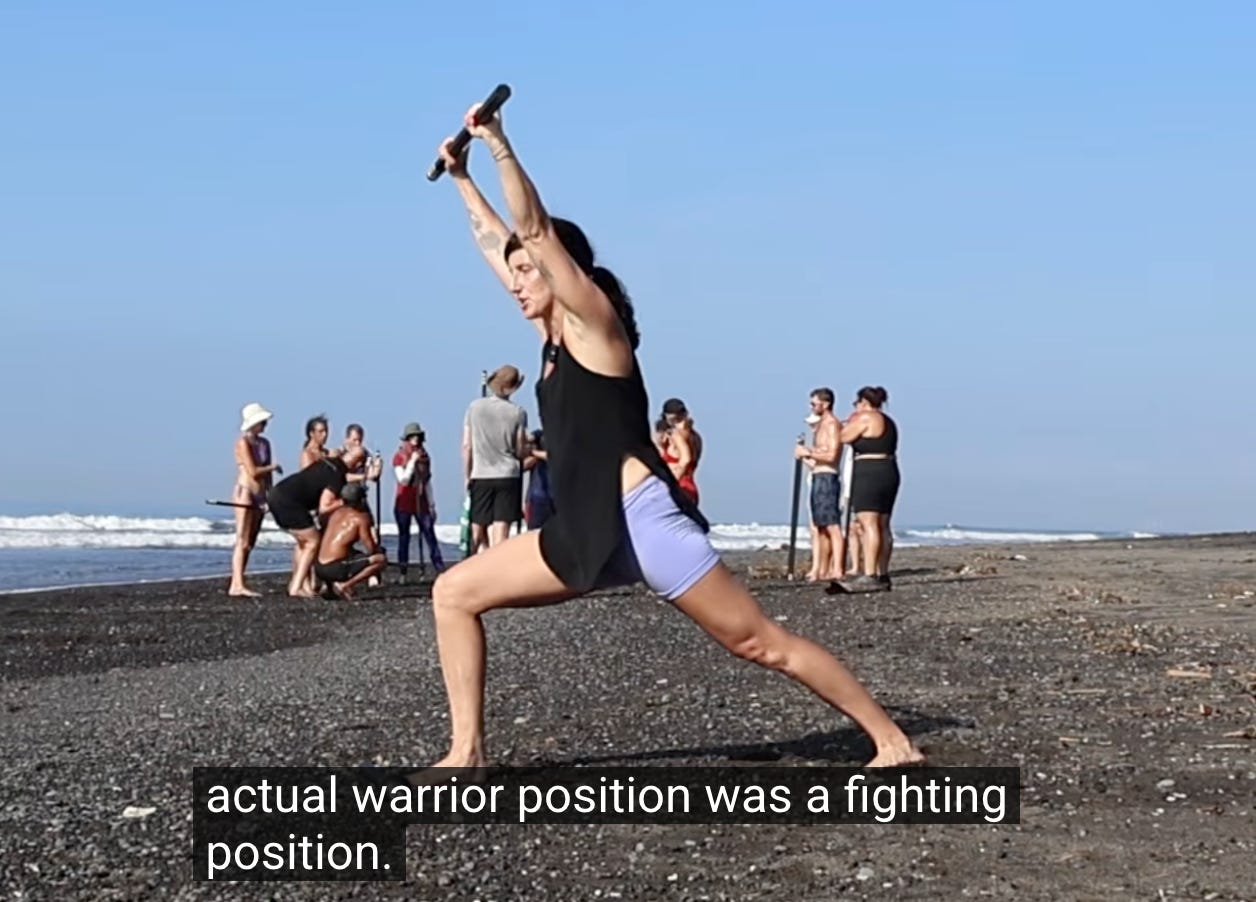
Warrior One
These claims sound captivating: yoga has warrior origins; modern yoga has lost its warrior origins; adding mace-bells to yoga practice restores something ‘original’ – and, even better, this restores something not only ancient, but actually primal, ‘natural’, or essential to the human. (Huntington claims ‘most people’ find it ‘easy’ to get into warrior one, precisely because it is a ‘natural’ human ‘movement pattern’.)
The only problem here is that there is no evidence for any of this. These are mythic origin claims that assume a fixed original essence from which later versions of yoga have developed/degraded. What there is evidence for, however, is that while Warrior One may draw its name from Hindu mythology (Virabhadrasana I), it only entered modern yoga practice in the twentieth century. The asana is said to honour Virabhadra, a fierce warrior created by Shiva from a lock of his hair after Shiva’s wife Sati self-immolated at her father Daksha’s sacrificial ritual, to which Shiva was not invited. Virabhadrasana I is said to depict Virabhadra emerging from the earth with two swords raised overhead, thrusting upward to destroy the ritual.
This is a captivating story. Among yoga practitioners, it is widely regarded as symbolising (not literally enacting) the spiritual battle against ignorance (avidya), and not literal violence.[1] Furthermore, despite its ancient-sounding mythic content, it is crucial not to forget that the name, the story, and the interpretation, are all merely the deployment of a myth that has been projected onto a modern yoga asana in recent times. Virabhadrasana I is not found in ancient hatha yoga texts. It first appeared in yoga through Tirumalai Krishnamacharya in the early twentieth century. His student Pattabhi Jois first photographed it around 1939.
The twentieth century temporality of all of this may surprise those invested in the idea of yoga as straightforwardly ancient. Nonetheless, contemporary scholars of yoga history tend to approach the development of yoga as we know it today in relation to two intertwined forces. The first is yoga’s intertwinement within international movements in nineteenth century nationalism, and subsequent twentieth century entrepreneurialism and the packaging of yoga as an ancient Indian practice in the studios and spas of Europe and North America (Putcha 2020). The second, connected to this, is the phenomenon known as the ‘invention of tradition’ – a major process of national identity building that historians identify with the modern era (Hobsbawm and Ranger 1983; Singleton 2010).
When viewed in an international frame, with adequate historical context, and without projecting ideas or fantasies of fixed essences back into romantic ideas of the mists of time, it is possible to see that the development of yoga as we know it today involves modern cross-cultural borrowing and creative entrepreneurial innovation much more than it involves the endurance of any ancient unbroken cultural tradition, or indeed ‘ancestral memory’. Indeed, historians note, before the twentieth century, ‘yoga’ was not defined by asana practice (Singleton 2010, 2011). Warrior One was most likely devised with reference to and in a kind of practitioner dialogue with (and against) European physical cultural movements of the nineteenth and early twentieth century (Khimich et al. 2025; Singleton 2010). It strongly resembles poses seen in Niels Bukh’s 1924 Danish gymnastics book Primary Gymnastics, which itself was influenced by nineteenth century Scandinavian traditions (traditions that had also reached physical educationalists in India). The impact that the development of nationalism had on physical cultural practices the world over cannot be overstated (Anderson 1991; Morris 2004; Khimich et al. 2025; De Michelis 2004). Governments instituted physical exercise curricula that most fitted their emergent nationalist narratives; countries sent their most unique, striking and exciting practices to World Fairs and Great Exhibitions/Expositions (Goto-Jones 2016); anthropologists studied and reified non-Western cultures’ practices (Said 1978); and tourists and travellers took all manner of pilgrimage and voyage of (self) discovery to far off exotic lands.
Dutch Flows
Harbert Eggert’s social media handle is ‘The Flowing Dutchman’. His improvised outdoor performances with heavy steel clubs and steel maces in the parks of Amsterdam – along with classic vaudeville-style strong man challenges to audience members (to see if anyone could hold a heavy mace vertically in one hand, etc.) – led to a large social media following. Eggert capitalised on this by filming more and more of his demonstrations, and also – significantly – his trips to India.
In these videos, Eggert journeys to what are positioned as the fonts and sources of different kinds of heavy club swinging. He visits wrestling akharas and kalaripayattu clubs all over India. These trips are videoed, edited, and posted on his various channels. In this process, Eggert has tried many different kinds of heavy clubs, and also studied Indian kushti wrestling and the Indian martial art of kalaripayattu. Via the popularity of his videos, Eggert set up online training courses, online sales of various kinds of club and mace, and established the Dutch Flow Academy. This has both physical and online incarnations, and under its auspices he trains and accredits people as instructors in various aspects of Indian clubs.
This is all carried out in the mode of fascination, obsession, delight, enjoyment and playfulness. However, a certain academic also looms large: the spectre of ‘extractivism’.
In ethnography and anthropology, ‘extractivism’ refers to exploitative practices in which researchers extract knowledge, stories, or data from communities without meaningful reciprocity. Methodologically and ethically, it is regarded by contemporary academics as being akin to resource plundering in colonial economies. Anthropologists critique extractivism as a metaphorical extension of raw material extraction, involving asymmetrical power flows that prioritize Western gain over non-Western participants’ needs or benefits. It is regarded as mirroring or echoing colonial capitalist exploitation, as field sites become ‘mines’ for data to be ‘harvested’, unidirectionally. Scholars critique any ethnography that takes advantage of communities through one-way knowledge flows. Of course, ethnographic or anthropological extractivism differs from direct economic ‘extraction’, but it repeats non-reciprocal power and economic dynamics. In some cases, it is regarded as leading to forms of standardisation, homogenisation or cultural conflation that renders specific and precise local knowledges both interchangeable and exchangeable while erasing singularities and particularities.

It might feel harsh to connect the invariably happy and friendly social media output of the Flowing Dutchman with extractivism. Indeed, his approach arguably demonstrates several counter-extractivist practices. For instance, his video content always emphasizes two-way engagement rather than unidirectional data extraction. He documents practices of mace and club training traditions and styles from India and other cultures, and he clearly frames this within a broader commitment to community participation and skill-sharing. He films himself with Indian experts embedded within their training cultures.
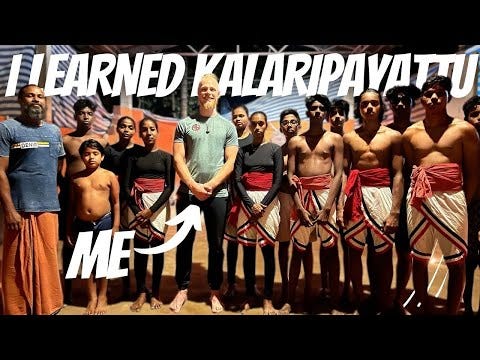
His documentary work may even seem aligned with a decolonial ethos of participatory knowledge production, rather than extractive research. He clearly collaborates with the practitioners he encounters, and his films show shared passion and community atmosphere. His discussions reveal his focus on how people transform their lives through engagement with club training, and he engages participants as agents rather than passive data sources. In addition, Eggert explicitly acknowledges the history and cultural contexts of the tools he teaches (particularly Indian gada/mace traditions), documenting his own learning journey rather than appropriating knowledge without attribution. This contrasts with extractivist knowledge practices that decontextualize and commodify local practices without recognition.
Nonetheless, his work irreducibly operates within the social media content economy, which supports other commercial aspects – paid courses, coaching, certifications, merchandise, etc. This kind of commodification of knowledge, even if shared reciprocally, raises some questions. There is a sharp distinction between collaborative knowledge production and independent or individual knowledge monetization. This is particularly significant given the non-Western sources of the practices he studies and integrates. Accordingly, the relationship between his documentary projects and the practitioners he engages should be assessed in terms of whether those communities have agency over their representation and/or receive any financial benefits from the distribution of their images and performances. We might also enquire into whether his source communities are in effect merely being ‘mythologised’: used to paint a certain picture of foreignness, on the basis of which the knowledge, experience and ultimately expertise that Eggert accrues becomes the true object and commodity for sale.
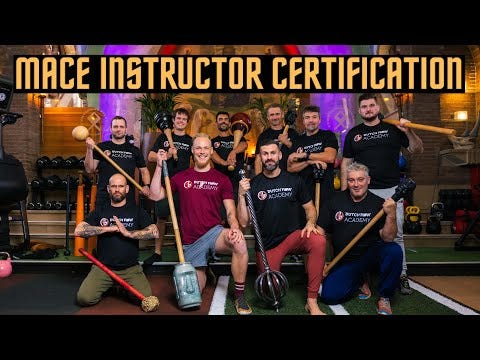
Certainly, after visiting India, Eggert returns to Amsterdam and positions himself as de facto ‘expert’ and ‘master’ of mace practice. He trades on his ‘authentic’ experiences and first-hand knowledge with Indian practices. On this basis, his Academy certificates ‘Master Mace Instructors’. This is arguably a classic extractivist set-up: having harvested knowledge from dispersed, non-Western practitioners, it is synthesized through a Western pedagogical apparatus and re-distributed it under branded institutional authority. The knowledge becomes ‘his’ system, his certification, his expertise.
Moreover, even before this, we can see that in his ‘community’ and ‘pilgrimage’ style videos, he centralizes himself in the video output. What is primarily held up for our inspection and admiration is him – his body in action. We often see Eggert performing with extremely heavy gadas and other clubs, to the delight and amazement of an assembled Indian audience.
This may be aligned with various problematic mechanisms, from Eurocentric cultural extractivism to mandatory entrepreneurial ‘Instagrift’, and more. Nonetheless, by constantly appearing as the star of the show, often as the most impressive performer, often as authoritative instructor, often as guide and interpreter, he establishes himself as the epistemic gatekeeper.
The communities and practitioners from which knowledge originates become sidelined or comparatively silenced sources. Viewers encounter foreign knowledge through his mediation and framing. This mirrors both extractivism and what Edward Said regarded as the exemplary operation of orientalism: the collection of Eastern knowledge and its installation and institutionalisation in the West (Said 1978). The childlike delight and laughter of Eggert’s online persona become what Barthes would call the ‘depoliticised speech’ that defines myth.

Athletic Savages
Mark Wildman’s company is Wildman Athletica. His YouTube bio describes him as ‘a celebrity trainer in Los Angeles’. He writes: ‘I focus on heavy clubbell and kettlebell training. Mobility is the key to your health. (and yes... that’s my real name)’ (Wildman 2016). Since November 2016, Wildman has posted over 1.5k videos and has almost 4k subscribers. (On Instagram, he has more again.) He specialises in demonstrating heavy steel club and kettlebell exercises, breaking movements down into their key components, and emphasizing which aspects of each movement a learner should focus on to maximise what he calls ‘athletic response’. Wildman emphasizes the importance of correct posture and biomechanics in all exercises and movements. ‘Stand all the way up’, he regularly enjoins us (unwittingly echoing countless Victorian schoolmasters and mistresses (Gilman 2018)), invariably adding: ‘because that’s what makes us human’.
In almost all of his videos, Wildman pins his colours to the mast of science – the science of human physiology. Yet, at the same time, his ‘scientific’ discourse almost always draws on powerful Rousseauian myths of the ‘noble savage’. In myriad videos, Wildman focuses overwhelmingly on ‘good posture’ and two further themes: first, ‘throwing patterns’, and second, what the ‘human’ use of ‘levers’. These two skillsets, he argues in many hundreds of videos produced across a decade, are ‘what make us human’.
Within two months of his first video, on the 25th January 2017, Wildman offered a ‘History of Heavy Club Swinging’ (Wildman 2017). In this 5-minute 20-seconds monologue, Wildman proposes that clubs have been present in human culture since before the earliest records. He first mentions Gilgamesh’s use of a club in ancient Mesopotamian mythology and then proposes that humans have trained with clubs since prehistory (‘clubbing is older than actual history’, he says at 2 minutes 10 seconds). He lists numerous figures, countries and cultures that have featured clubs in their myths and histories – from Greece to India, Persia, the British army in India since the 18th century (Heffernan 2024), and, he notes with a shrug, the Hitler Youth. (With the latter observation, Wildman is touching upon the expansive modern history of ‘group drill’ approaches to physical education, mentioned earlier, in which, all across Europe and North America, physical education took on regimented military forms, among which surviving films of Hitler Youth exercise demonstrations are but one example.)
As well as being ‘older than actual history’, Wildman also claims that club training was lost to the West after World War Two because of changes in military training. Here, he claims, Indian Club drilling was replaced by ‘basic training’ approaches to exercise, such as press-ups, sit-ups, and running. Thus, Wildman proposes that we are currently in a kind of renaissance – a process of rediscovery. However, for him, this is a rediscovery neither of Hellenic nor Asian nor modern colonial practices, but rather of a generalised prelapsarian human essence. His final words in the film (at 5-minutes 10-seconds) are: ‘Get a clubbell. Learn to use it. Be more human’. In such universalisation, reiterated across his oeuvre, Wildman deracinates the cultural specificity of different kinds of clubs, and different approaches to using them, and positions the modern steel ‘clubbell’ (an item and a term first promoted and patented by the entrepreneur Scott Sonnon in the early 2000s) as if this modern invention were actually some kind of transhistorical archetype.
As Broderick Chow observes, a cluster of ideas about a ‘transhistorical and transcultural ideal’ of the body are ‘difficult to shake’. Referring to the functional fitness movement in general, he notes that many ‘rediscoveries’ of the ‘prehistoric’ are often
illustrated by pictures of shirtless men in ‘natural’ environments, doing fitness exercises their Cro-Magnon ancestors would do: carrying logs through the forest, hanging on tree branches, wading waist deep in streams, sparring with each other. The illusion would be convincing were it not for the whiteness of the men in the images, the technical fabric board shorts they all wear, and their uniformly muscular and ripped physiques. (Chow 2024, 11)
Far from being actually transcultural and transhistorical, Chow argues, the history of such practices in fact ‘originated in the nineteenth-century popular theater as spectacles of strongmen, bodybuilding, acrobatics, and wrestling’. It was not until the twentieth century that feats of strength ‘legitimated themselves into practices of fitness and health. This point of origin’, he argues, ‘historicizes the idea of the fit body, making clear its relation to industrial capitalism and severing mythic notions of an unbroken connection to the ancient Greeks or the prehistorical “natural”’ (Chow 2024, 12). The fact that the current use of heavy steel clubs emerged in the early twenty-first century (as an attempt to follow up on the kettlebell craze of the early 2000s) does not trouble Wildman at all. His regular invocation of a transhistorical, transcultural, universal history, is actually allochronic fantasy.
The Noble Savage in the Room
Practitioners of heavy club swinging regularly invoke fantasies not just of ancient or primal human movements (something shared in common across all functional fitness discourse), but also ancient foreign cultures. They regularly evoke a primordial noble savage who still dwells somewhere in our ‘lizard brain’. Hence, when examined critically, what becomes visible is a reiterated pattern of romanticized primitivism that draws heavily on noble savage tropes, which reiterate, recapitulate and reactivate broader orientalist, essentialist and quasi- or crypto-colonialist tendencies in contemporary fitness culture.
The noble savage image was established in the eighteenth century. It is often connected with Rousseau, although Rousseau never actually uses the phrase ‘noble savage’ (or bon sauvage). Rather, the association comes from later readers’ interpretation and summary of his account of ‘natural man’ in works such as the Discourse on the Origin of Inequality. In fact, the phrase itself and the broader mythic figure pre‑date Rousseau, and grow out of classical primitivism and early modern travel writing, with the phrase ‘noble savage’ first attributed to John Dryden, in his 1672 play, The Conquest of Granada.
The noble savage image presents an idealized vision of ‘uncivilized’ peoples as morally superior to those corrupted by civilization. This framework manifests clearly in heavy club training discourse through several key elements. The first might be called temporal nostalgia and historical romanticism. Wildman and Huntington consistently frame club training through appeals to ancient authority, often making statements like ‘clubbing is very, very old; so old that it’s probably older than actual civilization’ (Wildman 2017). Wildman’s rhetoric positions his training tools as connecting practitioners to a pre-civilizational golden age when humans possessed superior physical capabilities and wisdom. To reference already mythological figures like Hercules and Gilgamesh is to paint a picture of club swinging as ‘older than civilization’, and therefore more authentic.
Going hand in hand with this is the Romantic claim of the corruption of modernity. Wildman’s discourse consistently evokes a mythic contrast between the ‘pure’ and ‘natural’ movement patterns of ancient peoples with the degraded state of modern humans. He argues that ‘people sit down all the time and when they go to the gym they lift in straight lines’, positioning even contemporary exercise as fundamentally corrupted when compared to the natural throwing patterns that ‘define humans’. This directly echoes the noble savage trope’s central premise that civilization corrupts natural human goodness (Wildman 2017).
Primitivist ideology is shared in common by ‘primal movement’ and ‘functional fitness’ communities. Their discourse consistently presents hunter-gatherer movement patterns as superior to modern exercise, with practitioners implicitly and explicitly claiming that ‘primitive men and women’ possessed optimal fitness naturally (Dalleck and Kravitz, n.d.; Dangerously Fit, n.d.; Scott-Dixon 2021; Senart 2013). Prominent are constructs like ‘the seven primal movement patterns’. Such concepts exemplify the romanticization central to the discourse, with advocates frequently asserting that these movements ‘have deep roots in human ancestry’ and were ‘essential for survival’. The underlying assumption is that pre-agricultural humans lived in harmony with their bodies and environment, while modern civilization has corrupted these natural patterns (Dangerously Fit, n.d.).
Hence, heavy club practitioners frequently invoke the figure of the ‘ancient warrior’ – ‘Warrior Number One’, so to speak – as the idealized practitioner. This archetype embodies the noble savage’s key characteristics: physical prowess, moral clarity, and connection to nature. In this mode, Wildman celebrates ‘The Great Gamma’, a wrestler who allegedly performed 1,000 shield casts daily with an 80-pound club, and presents this as evidence of superior ancient training methods. Wildman neglects to mention that Gamma was a twentieth century wrestler who established his own training regimen. Summer Huntington, as we have seen, projects yoga’s Warrior One pose back into the mists of time, and by the same token deep into our primordial ‘lizard brain’.
As an aside, it seems valuable to point out that the term ‘lizard brain’ derives from 1960s evolutionary theory. The classic version of this theory proposes that the human brain has a primitive and ancient ‘reptilian’ core to the brain, then a less old ‘mammalian’ layer, and finally a rational ‘human’ neocortex on top. The current scientific view is, in a nutshell, that the popular idea of a human ‘lizard brain’ is overly simplistic and mostly wrong as a model of brain evolution and behaviour. It has some value as a crude metaphor for our ingrained ‘automatic’ reflex responses to threat, surprise and fear, but it is not a scientifically accurate explanation of why humans feel fear, anger, or impulsive urges. Modern neuroscience prefers language about interacting networks, including threat detection, emotion regulation, memory, and social cognition, rather than a single primitive module.
Nonetheless, it is all part of what makes such discourse so appealing. It wraps romantic primitivism in scientific language, and sells the sense that we can access our true noble savage natures by exercising in this way. Practitioners cite evolutionary arguments about ‘natural’ movement patterns while simultaneously engaging in what anthropologists recognize as classic noble savage romanticization (Rapp 2024; Scott-Dixon 2021). The discourse of ‘ancestral movement’ and ‘primal patterns’ presents itself as evidence-based while actually perpetuating the same myths about pre-civilizational human superiority that have characterized Western thought since the Enlightenment (Rapp 2024).
Simulacra
Contemporary club and mace training discourse as seen across social media today invokes and draws on noble savage fantasies in a wide range of ways. Of course, it is not alone or idiosyncratic in doing so. Rather, it is one style of discourse that needs to be understood within a broader context or landscape that is populated with anxieties or senses of alienation, identity anxiety or crisis, the felt lack of perceived cultural roots, the desire for authentic experience, and a certain drive to legitimate appealing romantic primitivist beliefs. The romanticization of primitive strength training serves psychological and cultural functions beyond simple ‘nostalgia’ for the sense of a lost time, world, or version of humanity. It provides practitioners with a sense of authentic embodied physicality and connection to imagined ancestral wisdom while also offering a kind of escape from the perceived corruption of modern life.
However, this discourse ultimately reproduces the very orientalist and primitivist assumptions that historically justified Western cultural superiority while simultaneously appropriating and decontextualizing non-Western training traditions. The ‘noble savage’ centralised in heavy club training refers less to actual historical or contemporary peoples and more to Western fantasies of pre-civilizational purity projected onto convenient cultural artifacts.
This is all particularly palpable when reflecting on how such discourse selectively appropriates elements from various cultures (Indian clubs, Persian maces, or even European medieval weapons, etc.) while stripping away their actual historical and cultural contexts in favour of a generic ‘ancient warrior’ mythology – making them into simulacra. This serves contemporary psychological desires and fantasies about a kind of authentic communion with the primal source, while actually generating something that is better regarded as a postmodern simulation. Indeed, once noticed, it is possible to see that the dimension of simulation runs deep, through all aspects of club training discourse.
Simulation
A critical reader of this article may query why I have prioritised some of the arguably marginal or supplementary imagery used by club proponents when, in actual fact, their explicit focus and direct claims all relate solely to pragmatic, practical functionality, in the here and now. Functional fitness and circular strength training discourse primarily claims that it will lead to improvements in sporting or athletic prowess. However, it is worth noting that, despite some of the dramatic claims often made by proponents, academic research actually suggests something of a disconnect between the claimed sport performance benefits of such training and actual evidence.[2] There is a limited amount of ‘transfer evidence’.[3] In fact, there is arguably a paucity of scientific data supporting circular training proponents’ often dramatic claims about its direct benefits, especially when compared or contrasted with other approaches to exercise or sports training.
As a cultural studies scholar rather than a sports scientist, I am unable to comment on the disputes about the scientific or objective status of functional fitness and/or circular training’s claims. As someone who exercises, I very much enjoy swinging Indian clubs, heavy clubs, maces, and kettlebells. As I have written before, the affective, phenomenological and somaesthetic dimensions of such practices are compelling (Bowman 2026a, 2026b). However, what should be resisted in and around such practices might be called the performance of authenticity (Daudi 2022; Riemer 2020; Rörström and Grist 2022).
For instance, we often see (as in Huntington’s Warrior One with mace) what might be called a simulation of imagined ‘aesthetic authenticity’. Huntington proposes that because she thinks that holding a mace in the hands in Warrior One looks a bit like a martial arts overhead block, therefore it must really be a ‘hidden’ or ‘lost’ natural or athletic movement. Such practitioners prioritize movements that they think look natural, fluid, and ‘functional’. The emphasis on ‘movement quality’ and ‘flow’ creates a visual culture (or culture of the image) wherein aesthetic authenticity is performed for different kinds of fantasy rather than any other purpose (Riemer 2020). The appeal to ancestral wisdom in the evocation of ‘ancient’ training methods serves as what arch-theorist of postmodernity Jean Baudrillard, would recognize as the simulation of depth and meaning (Scott-Dixon 2021). These tools are recontextualized not as products of specific cultural practices but as generic signifiers of authenticity. Their true functionality is in their simulation of a mythic structure of feeling.
Unification
I began this article with the subtitle ‘Separation Perfected’. Some readers will be aware that this is also the title of the first chapter of Guy Debord’s influential 1967 work, The Society of the Spectacle. Using it was a kind of dog whistle that telegraphed for some readers my argument that functional training was going to be regarded as connected more with performance and spectacle rather than utility. This is because, as Debord identified in the 1960s, in a media-saturated society, ‘social relations among people’ become increasingly ‘mediated by images’ (Debord 1990, 1994). This inexorably leads to the commodification of ‘authenticity’. Fitness culture transforms certain movements, deemed authentic, into commodity (and) spectacle. This is the basis of any number of the endlessly proliferating ‘double sells’ we encounter everyday online and in other media. What may or may not have begun as a desire for the real, for practical training, for utility and functionality, etc., becomes ‘an immense accumulation of spectacles’ (Andreasson and Johansson 2014; Bell et al. 2023; Hearse 2021).
To stick with Debord’s imagery and argument a little longer, this produces what might be termed ‘separation through unity’: the functional movement community creates apparent unity around ‘natural’ movement while actually capitalising on the separation of practitioners from direct embodied social and functional experience. Mark Wildman, in particular, often sells club training as a way to get better at real activities, such as – and this is one of his own repeated examples – chopping wood with an axe.
The Woodcutter
At the end of Mythologies, Roland Barthes offers the image of the woodcutter as the very exemplification of authenticity qua absence of myth. For Barthes, the woodcutter escapes the culture of the image and also avoids alienation. The woodcutter is at one with ‘his’ world and ‘his’ work. His speech about his tools, his environment, trees and wood is as good as it gets: free from myth, the real thing. Man, environment, tool, skill – harmony. Hmmm. Critics have noted that, really, therefore, Barthes merely offers one myth to counter myth: his fantasy woodcutter is his ‘good myth’, proposed to counteract the ‘bad’ (i.e., ideological/media) myths produced by and circulating within and further dividing a divided and antagonistic capitalist society.
A key difference between Mark Wildman and Roland Barthes, then, is not that Wildman is a twenty first century ‘Hollywood’ movement and exercise trainer while Barthes was a twentieth century rive gauche Parisian intellectual who valued reading and writing and literature and philosophy and theory and criticism over most other things. Rather, it is that Barthes would most likely not advocate practicing woodcutting with a club or mace before becoming a woodcutter; whereas Wildman – a club instructor and vendor – would be considerably more likely argue that buying one of his clubs or kettlebells and following one of his courses first would be no bad thing.
However, a key similarity between both Barthes and Wildman is that, even though Barthes’s career was defined by his cultural criticism, his development of semiotics and his contributions to literary and cultural studies, and even though Wildman is a ‘Hollywood trainer’, neither of them really care about the reality of this or that or any other woodcutter. Their work is neither about nor for woodcutters or woodcutting – even though Wildman often situates himself in dramatic natural landscapes for his YouTube videos, and even though Barthes clearly fetishizes ‘wood’ (versus ‘plastic’) throughout the pages of Mythologies. Similarly, Huntington does not care about the reality of an overhead block with a staff or mace, nor about its historical veracity, and Eggert really only centralises himself in his travel videos and demonstrations across India. All tend to deploy myth against myth, their myth to counter someone else’s myth, noble myth to counter savage myth, constantly separating in an attempt – they claim – to unify.
However – whispers the spectre of Marx into Barthes’s agnostic post-Marxist ear – society is not unified, never unified: it is divided, riven, conflictual; antagonistic and antagonised. Anyone that says otherwise is a snake oil salesman, pedalling myth and ideology. Thus the key questions remain: what picture of the world is being presented? What are they selling? Asking and working out answers to these questions is fundamental.
References
Anderson, Benedict. 1991. Imagined Communities: Reflections on the Origin and Spread of Nationalism - Revised Edition. Verso.
Andreasson, Jesper, and Thomas Johansson. 2014. ‘The Fitness Revolution. Historical Transformations in the Global Gym and Fitness Culture’. Sport Science Review 23 (3–4). https://doi.org/10.2478/ssr-2014-0006.
Bardenett, Sean M., Joseph J. Micca, John T. DeNoyelles, Susan D. Miller, Drew T. Jenk, and Gary S. Brooks. 2015. ‘FUNCTIONAL MOVEMENT SCREEN NORMATIVE VALUES AND VALIDITY IN HIGH SCHOOL ATHLETES: CAN THE FMSTM BE USED AS A PREDICTOR OF INJURY?’ International Journal of Sports Physical Therapy 10 (3): 303–8.
Barry, Andrew. 2001. Political Machines: Governing a Technological Society. Continuum.
Barthes, Roland. 1957. Mythologies. Paris.
Barthes, Roland. 1993. Mythologies. Vintage.
Bashir, Marrium, Kim Geok Soh, Shamsulariffin Samsudin, Saddam Akbar, Shengyao Luo, and Jaka Sunardi. 2022. ‘Effects of Functional Training on Sprinting, Jumping, and Functional Movement in Athletes: A Systematic Review’. Frontiers in Physiology 13 (November). https://doi.org/10.3389/fphys.2022.1045870.
Bell, Deniece, Saidur Rahman, and R. Rochon. 2023. ‘(Trans)Forming Fitness: Intersectionality as a Framework for Resistance and Collective Action’. Frontiers in Sports and Active Living 5 (July): 944782. https://doi.org/10.3389/fspor.2023.944782.
Bowman, Paul. 2026a. ‘Imagined Somaesthetics and the Analysis of Embodied Ideology’. Martial Arts Studies 0 (20). https://doi.org/10.18573/mas.244.
Bowman, Paul. 2026b. ‘Somacoloniality: Three Figures of Embodied Postcolonial Affect (Indian Clubs, Gadas, and Heavy Clubs)’. Asian Journal of Sport History & Culture 0 (0): 1–19. https://doi.org/10.1080/27690148.2025.2577434.
Chow, Broderick. 2024. Muscle Works: Physical Culture and the Performance of Masculinity. Northwestern University Press.
Cook, Gray, Lee Burton, Barbara J. Hoogenboom, and Michael Voight. 2014. ‘FUNCTIONAL MOVEMENT SCREENING: THE USE OF FUNDAMENTAL MOVEMENTS AS AN ASSESSMENT OF FUNCTION‐PART 2’. International Journal of Sports Physical Therapy 9 (4): 549–63.
Dalleck, Lance, and Len Kravitz (The History of Fitness). n.d. ‘History of Fitness’. Blog. Accessed 18 August 2025. https://www.unm.edu/~lkravitz/Article%20folder/history.html.
Dangerously Fit. n.d. ‘An Introduction To The 7 Primal Movement Patterns’. Articles. Dangerously Fit. Accessed 18 August 2025. https://www.dangerouslyfit.com.au/articles/7-primal-movement-patterns/.
Daudi, Aurélien. 2022. ‘The Culture of Narcissism: A Philosophical Analysis of “Fitspiration” and the Objectified Self’. Physical Culture and Sport. Studies and Research 94 (1): 46–55. https://doi.org/10.2478/pcssr-2022-0005.
De Michelis, Elizabeth. 2004. A History of Modern Yoga: Patañjali and Western Esotericism. With Bloomsbury. Continuum.
Debord, Guy. 1990. Comments on the Society of the Spectacle. Verso. G01522694.
Debord, Guy. 1994. The Society of the Spectacle. Zone Books. Adv0100314619.
Flow Shala (Flow Shala). n.d. ‘Flow Shala’. Accessed 6 May 2026. https://www.flowshala.com.
Fransen, Job. 2024. ‘There Is No Supporting Evidence for a Far Transfer of General Perceptual or Cognitive Training to Sports Performance’. Sports Medicine (Auckland, N.z.) 54 (11): 2717–24. https://doi.org/10.1007/s40279-024-02060-x.
Gilman, Sander L. 2018. Stand Up Straight! A History of Posture. Reaktion Books.
Goto-Jones. 2016. Conjuring Asia: Magic, Orientalism, and the Making of the Modern World. Cambridge University Press.
Hearse, Phil. 2021. ‘Guy Debord and the Spectacle’. Anti-Capitalist Resistance, June 4. https://anticapitalistresistance.org/guy-debord-and-the-spectacle/.
Heffernan, Conor. 2024. Indian Club Swinging and the Birth of Global Fitness: Mugdars, Masculinity and Marketing. With EBSCOhost. Bloomsbury Academic.
Hobsbawm, E. J., and T. O. Ranger. 1983. The Invention of Tradition. Cambridge University Press, 1992. B9402863.
Huntington, Summer. 2026. How to Train Warrior Poses - with Steel Mace | Summer Huntington.
Jeffords, Susan. 1994. Hard Bodies: Hollywood Masculinity in the Reagan Era. Rutgers University Press.
Khimich, Vita, Yuriy Dutchak, and Natalie Demchenko. 2025. ‘German and Swedish Gymnastics Systems: Influence on Physical Culture’. Scientific Journal of National Pedagogical Dragomanov University Series 15 Scientific and Pedagogical Problems of Physical Culture (Physical Culture and Sports), no. 3K(188): 323–28. https://doi.org/10.31392/UDU-nc.series15.2025.03k(188).77.
Liu, Junyan, Lei Shang, and Hongjun Yu. 2024. ‘The Effects of Functional Training on Muscle Strength in Athletes: A Meta-Analysis’. Preprint, bioRxiv, June 6. https://doi.org/10.1101/2024.06.01.596934.
Morris, Andrew D. 2004. Marrow of the Nation: A History of Sport and Physical Culture in Republican China. University of California Press.
Philp, Fraser, Dimitra Blana, Edward K. Chadwick, et al. 2018. ‘Study of the Measurement and Predictive Validity of the Functional Movement Screen’. BMJ Open Sport & Exercise Medicine 4 (1). https://doi.org/10.1136/bmjsem-2018-000357.
Putcha, Rumya S. 2020. ‘Yoga and White Public Space’. Religions (Basel, Switzerland ) (Basel) 11 (12): 669-. https://doi.org/10.3390/rel11120669.
Rapp, Tristan Søbye. 2024. ‘The Myth Of The Noble Savage’. Noēma, July 9. https://www.noemamag.com/paradise-lost.
Riemer, Sigo. 2020. ‘A Conceptual Analysis of Movement Culture’. Blog. ThinkMovement, April 5. https://thinkmovement.net/2020/04/05/a-conceptual-analysis-of-movement-culture/.
Rörström, Kristina, and Adrian Grist (Malmö University). 2022. ‘The Dark Side of Fitness Culture Is Exposed on Social Media | Malmö University’. News. October 13. https://mau.se/en/news/the-dark-side-of-fitness-culture-is-exposed-on-social-media/.
Said, Edward W. 1978. Orientalism: Western Conceptions of the Orient. Penguin.
Scott-Dixon, Krista. 2021. ‘Synthetic Primal: Stone Age Fitness in the 21st Century’. Breaking Muscle, October 11. https://breakingmuscle.com/synthetic-primal-stone-age-fitness-in-the-21st-century/.
Senart, Alexey. 2013. ‘Back to Basic: How to Train Like Primitive Man’. StrongFirst, June 14. http://www.strongfirst.com/back-to-basics-for-real/.
Singleton, Mark. 2010. Yoga Body: The Origins of Modern Posture Practice. Oxford University Press.
Singleton, Mark. 2011. ‘The Ancient & Modern Roots of Yoga’. Yoga Journal, February 4. https://www.yogajournal.com/yoga-101/philosophy/yoga-s-greater-truth/.
Spatz, Benjamin. 2015. What A Body Can Do: Technique As Knowledge, Practice As Research. Routledge.
Tasker, Yvonne. 2012. Spectacular Bodies: Gender, Genre and the Action Cinema. Routledge.
Wildman, Mark (YouTube). 2016. ‘Mark Wildman YouTube Channel’. November 1. https://www.youtube.com/channel/UCVYbUVLrZ6pEBfYV_UyvItA.
Wildman, Mark, dir. 2017. The History of Heavy Club Swinging.
Xiao, Wensheng, Kim Geok Soh, Mohd Rozilee Wazir Norjali Wazir, et al. 2021. ‘Effect of Functional Training on Physical Fitness Among Athletes: A Systematic Review’. Frontiers in Physiology 12 (September): 738878. https://doi.org/10.3389/fphys.2021.738878.
[1] If it were about literal violence, then it would be worth noting that two swords thrust into the air is very different to one mace or club held horizontally overhead by vertical arms. Furthermore, the martial artist in me wants to add that holding the arms straight when executing any kind of roof block is also an exceptionally bad idea – but that is a critique of a different order.
[2] For instance, multiple studies suggest that the ‘functional movement screen’ (FMS) – which is a cornerstone of functional training discourse – lacks both measurement and predictive validity. Research shows the FMS ‘does not demonstrate the properties essential to be considered as a measurement scale’ and cannot prospectively identify athletes at risk of injury. More damning for the sport performance claims, the FMS was explicitly ‘never intended to measure sport performance’ (Bardenett et al. 2015; Cook et al. 2014; Philp et al. 2018).
[3] While functional training demonstrates ‘near transfer’ to related movement tasks, there is minimal evidence for ‘far transfer’ to actual competitive performance. This mirrors broader research showing that cognitive and perceptual training rarely transfers to real-world performance despite impressive laboratory results (Bashir et al. 2022; Fransen 2024; Liu et al. 2024; Xiao et al. 2021).

Comments
Post a Comment