Screw Exercise Snacking. Or: I don’t know why I train and neither do you

‘The goal is to keep the goal the goal’ – Dan John
‘Wo Es war, soll Ich werden’ [‘Where it was, shall I become’] – Sigmund Freud
Strength is a Pretext
I’m haunted by a comment I saw under a post. The post was all about a new approach to strength training being pushed by kettlebell entrepreneur Pavel Tsatsouline. In this new approach, you barely train at all. You hardly ever train. You never get out of breath. You never work up a sweat. You absolutely never chase a pump, or failure, or exhaustion. It’s kind of like exercise snacking. But if normal snacking involves snaffling a handful of cashew nuts a few times a day, Tsatsouline takes this to an almost homeopathic level. You take your small handful of nuts and eat only one nut per snack. In fact, you only nibble at a couple of these micro-snacks across a day, and only on a few days of the week.
To be clear: the snacks here are individual exercises – a Turkish get-up, maybe; or a bent press. According to Tsatsouline, this approach does amazing things for your strength.
I tried it. I didn’t like it. Well, full disclosure: I tried it. I immediately hurt myself. I’m not a big warm-up fan at the best of times, but it turns out I’m also not a zero-preparation fan either. It seems that my body does require a little bit of warning, sweet-talking, coaxing and a couple of practice runs before I can persuade it to do a near-maximal lift without complaint or consequence. I can’t just step away from the computer and do a heavy Turkish get-up or goblet squat every few hours, in the manner Tsatsouline seems to advocate. Or maybe I didn’t read the instructions properly. But anyway: back to the comment that haunts me.
Under a link to a social media post promoting Tsatsouline’s new product, someone wrote that they had been following this new approach and that they were indeed seeing strength gains. However, their mental health was suffering. They needed more than a few exercise snacks a few times a day a few days a week. They missed the gym, doing proper workouts, the expenditure of time and sustained effort, and that ‘certain je ne sais quoi’ that a good hard workout session gives – whatever that ‘certain something’ really is.
Misrecognised Intentions
This struck a chord in me. We think we want certain things – strength, say. We think we have aspirations and aims and intentions – to be stronger, say. We give reasons why we do things – especially things as intransitive as ‘training’, lifting weights, doing this or that kind of exercise. But, here’s the thing: such reasons may withhold more than they give, or cover more than they reveal. We might want something else entirely. We might need something else that training gives, something we had not noticed, maybe could not notice, because it is inherent to or identical with the activity of training itself.
The person who wrote the comment evidently thought that they trained ‘for strength’. Yet, when it turned out that the most efficient approach to gaining strength was now said to involve very little actual training, then they lost something – something important. Their stated aim, objective, or declared intention, turned out to have been a kind of alibi, or misrecognition (or what poststructuralists used to call méconnaissance).
The goal is principled drifting
Strength coach Dan John often uses the phrase ‘the goal is to keep the goal the goal’. This is a great phrase to keep in the head when training – especially training that is intransitive (i.e., open-ended, voluntary, and not tethered to a specific objective). There is every opportunity for drift when doing something as open-ended as walking into a gym that is brimming over with different kinds of pieces of kit, and when our heads are full of different theories and principles and factoids and potential different aims and orientations in the use of all of it.
However, Dan John’s axiom also points to an inherent tendency: drift. Or indeed change. In keeping ourselves tethered to a goal that we set ourselves at some point in the past, and not allowing ourselves to veer from the values and the required path that such a goal inherently required, we are refusing drift.
Drift might be regarded as being led or pulled away from the path, and hence as a bad thing. However, it might equally be approached as an inevitable consequence of pleasure, play, and experimentation – or, indeed, an inherent possibility of our very humanity. As Johan Huizinga sees it, we are essentially ‘homo ludens’ – playful animals.
Speaking of ‘the path’, or ‘the way’: Daniele Bolelli once proposed that strength training (resistance training, weight training) can be regarded as Daoist. He gives a range of reasons for this claim. Well, here is another: any Daoist ‘way’ involves modulations, waxing and waning, eddies and flows, light and shade, the drift from old yin to young yang and back again. This does not just mean ‘taking a de-load week every two months’. It means listening to your mind and body, following your curiosity, responding to your fatigue, the way factors force you to move around obstacles by changing your activities, and so on.
On the one hand, the primary intentions you think you established and articulated for yourself back when you decided that strength was the goal may have been badly formed or imprecisely expressed. On the other hand, maybe our desires, intentions and interests are inevitably going to change. Put differently: getting bored of deadlifts is inevitable, so maybe we should be prepared to move on from them. We may soon enough start to miss them, and come back with renewed passion. Or if we don’t miss them, then what does that tell us about their importance to us? Indeed, if we find that we want to drift away from the gym entirely, really, is that so bad? Shouldn’t we pay more attention to the changing constellation of our interests than to an arbitrary moment in the past when we made a contract with ourselves? I’m not saying be anchorless or rudderless. I’m not saying be a snowflake. I’m saying: constant dialogue, self-interrogation, listening, responding. As cultural theorist Lauren Berlant famously argued, sometimes our earlier investments and attachments can become cruel. Should we stick with them?
Forget Freud
To test a theory, Freud would hypnotise patients and tell them that when they awoke they must not walk directly across the room. When he woke them, he would then casually ask them to nip across the room to get something or do something. On cue, they would skirt around the edges, or zigzag, or whatever they needed to do to avoid going straight across the room. When he then asked them why they had not just walked directly from A to B, they would come out with all sorts of excuses – I just wanted to look at that picture, I thought I saw someone I know outside the window, and so on. Freud used this as evidence to argue that our ego is there to fib to us, to make excuses on behalf of our unconscious, and to provide narratives, explanations and ex post facto rationalisations that are always primarily designed to make it sound like we are consciously in charge of ourselves.
Like if we say we ‘train for strength’. But do we? Our online commenter clearly wanted or needed something else, something different from or in addition to their stated aims.
I am constantly in conversation with myself about what I train for. Strength is great, yes. But is it that I really want something else, something that the feel of a few increasingly heavy sets gives me, that cannot easily be put into words? Surely, words and values are entangled in this. Philosopher Richard Kearney calls it ‘carnal hermeneutics’ – the irreducible entanglement of words and feelings, or ideas, interpretations and embodiment. If I can add some extra weight plates to the bar for my final set, it means something good to me. But it has to feel ‘right’ to me before it is worth it, before it really means something to me.
Imaginary, Symbolic and Feel
Our conscious intentions can be alibis, concealing other things. We might not really know why we do something. We might not fully notice that it is a feel – a feel intertwined in words and meanings, sure. But a feeling that, because most of it exceeds language, we therefore cannot put into words.
There are some words for some of the feels. But this vocabulary is puny. ‘The pump’ is the most well-known term. What other terms are in use for the experiential dimension of strength training, resistance training? Adjectives, mainly; evaluations of feels, not a vocabulary for them.
Of course, we have some sayable reasons, the public face of our activities. (‘I train for strength’.) We also have some unsaid reasons, reasons we may not want to advertise. (‘I train because I hope it will make me become more desirable’. Or ‘I still fantasize about being like my childhood hero [and of course, I still secretly think that this will make me more desirable]’. And so on.) And then – I am suggesting – there might be a whole host of other ‘reasons’ about which we effectively know nothing.
Readers who have some knowledge of the psychoanalyst Jacques Lacan (or one of his cultural theory interlocutors such as Slavoj Žižek) might notice this triumvirate and say ‘Aha! Symbolic, Imaginary, and Real’.
In Lacan’s schema, humans operate in the symbolic order – the world of language and meanings and values. Training for strength or health and fitness or longevity or even image all makes sense here. You can say it. But we also inhabit the Imaginary. This is the stuff of daydreams – idealisations, perfection, peace, bliss, resolution, conclusions, happy ever afters. In the Imaginary, we can be desirable superheroes, and it is great. And finally, of course, there is the Real. The Real is that which resists symbolisation, escapes language, cannot be signified.
Plaiting Braids, Braiding Plaits
‘Doing something’ and ‘giving reasons’ for why you do it are different. They are inevitably intertwined, but they are different. Surely, doing and having reasons for doing are reciprocally constitutive. But they are also in principle separable, like different segments of hair that are pulled together to make braids or plaits. (I say ‘braid’ because braid is American for plait, but I want to say plait, because plait is British for braid.)
Without the different segments, pulled together and woven together in a particular way, there is no plait. The plait is one thing, certainly, but you can look at it and see its different constituent sheafs of hair, and within each of these, individual hairs.
I like this image. It seems potentially helpful to think with and through.
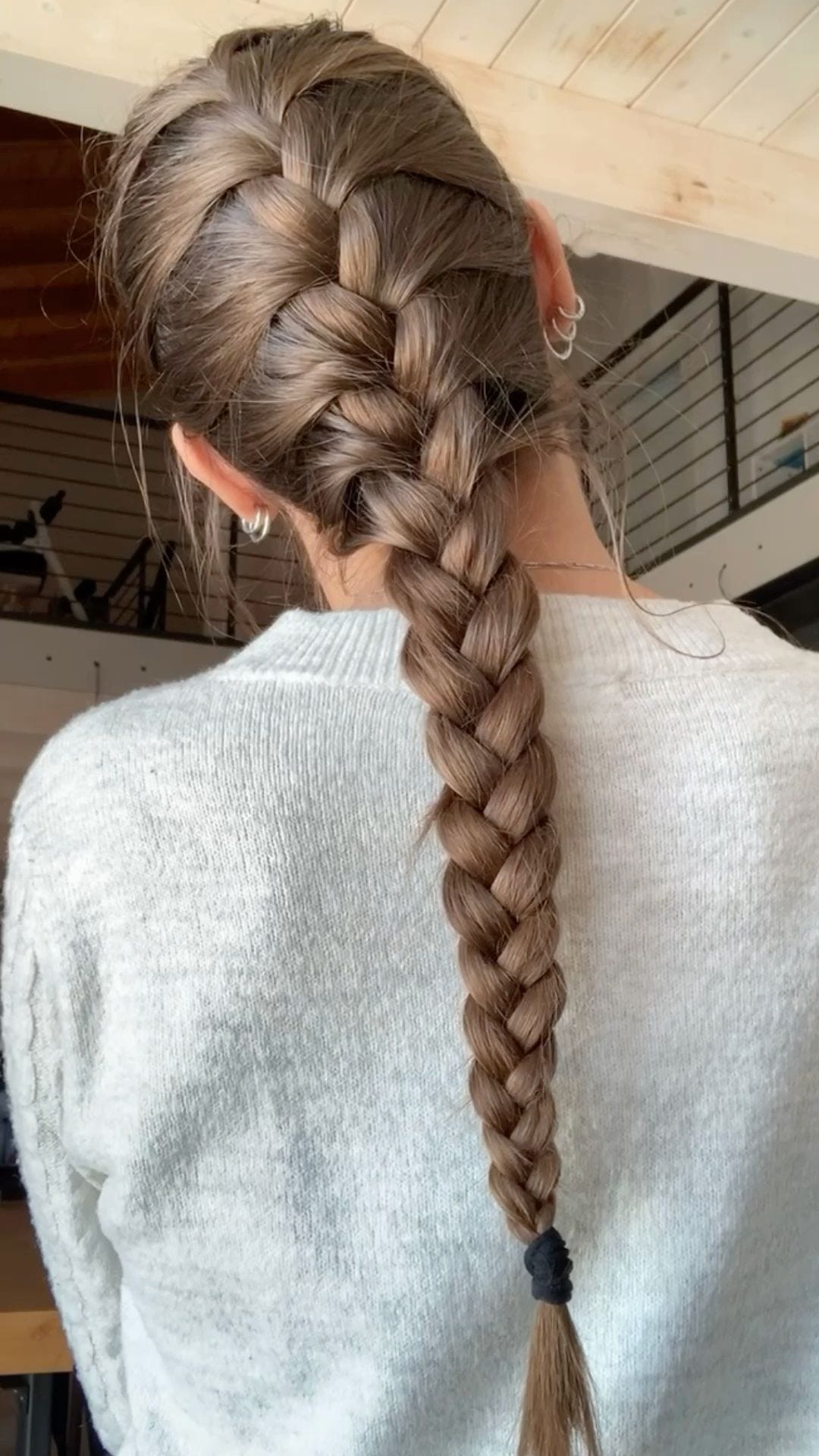
If we think of an activity like weightlifting or strength training as a braid or plait of three segments, then each of the three segments of hair can be mapped onto our triad. One bunch might be the reasons we give about why we do this thing. This is the ‘attending discourse’ – the public discourse, in the public realm of the symbolic order. It is made up of the words used by others and by us when we think or talk about our activity. It is from the options available to us in this attending discourse that we construct our reasons.
The second assemblage in the tripartite weave would be our secret unsaid fantasy hopes and dreams and satisfactions – things we might never say out loud, but they are there (Lacan’s Imaginary). And then the third would be the dimensions of it all that we aren’t fully aware of, or that we are unable to put into words, or even to visualise or perceive directly. We might think of this as Lacan’s Real, Žižek’s sublime, Polanyi’s tacit, Deleuze’s affect. And more.
I have trained (intransitively – i.e., open-endedly) on and off over many years in many ways and I have given many reasons for it. I have also harboured secret quiet reasons that I haven’t spoken too much about but that I always knew were there, perhaps providing more motivation and more motive force than any stated motivation. Then, there is that third strand – that je ne sais quoi, the ‘can’t be put into words’ bit. I am aware that it is there, and finding ways to perceive it, conceptualise it, express it, convey it, has become something of an obsession of mine.
The first segment of my training plait – the reasons I have given for training – has changed a lot over the years, depending on my age, my orientations, my activities, and who I am talking to. But the other two realms – Imaginary and Real, or fantasy and affect. . . I wonder whether they have changed much at all. After all, whether you’re doing a kettlebell snatch or a bent over row for reasons/alibis of self-defence, athletic prowess, competitive ability, or simply to try to develop a physique that looks good, the snatch and the row will give the same physical stimulus, even if we read it, narrate it, or fantasize about it differently, at different times.
The Magic Number
I’ve painted a picture of a three-sectional braid or plait here, as a way to think about the complexity of ‘reasons’, ‘intentions’, or what we want and get out of practices like resistance training. However, I feel it important to say that ‘three’ is not a necessary number here.
Three is a seductive number. It’s a big number in Christianity, magic, in psychoanalysis, engineering, cartography, and more. A lot of people have a lot of time for threes. It has a history. It has form. However, the philosopher Jacques Derrida told us to watch out for it. Instead of the seductive three, Derrida proposed thinking in terms of four. I think he did this because three makes a holy trinity while four makes a square, and a square kind of looks like or evokes the four walls of an institution. And Derridean deconstruction was always focused upon the institutional forces and factors that determine meanings and values. But maybe that’s just what I like to think, rather than being connected to any compelling evidence from Derrida’s text itself.
Either way, let’s back-pedal a bit, and move away from the comfortable three. However, rather than going up to four, let’s go down to two; or, rather, to one becoming two. Let’s think about the Möbius strip.
Möbius Strip
Cultural theorist Elizabeth Grosz once used the image of the Möbius strip to express the complex relation of our inside to our outside. Like the Möbius strip, the outside of our selves is also our inside. And vice versa. Any part of our outside is equally our inside. Our skin is not simply our outer limit; it is part of our innermost identity; our innermost identity (or id-entity) manifests on surfaces.
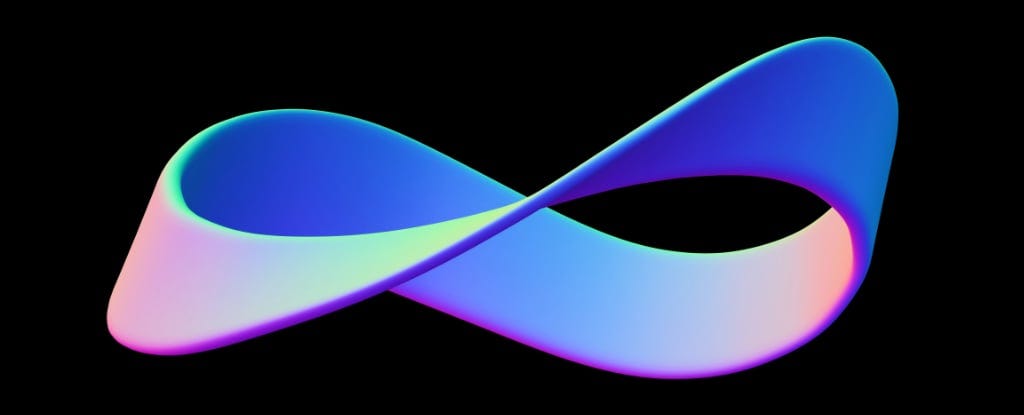
I think of this image a lot, such as when I think of the status of reasons, motivations, or stated intentions. Our externalised alibis dovetail with or fold into unspoken, unspeakable, unconsidered, unnoticed, ignored, and other elements and aspects. Put differently, our Möbius strip selves are not simply one strip. There are braids, plaits, tangles, loose hairs, Gordian knots.
The Möbius Plait
Grosz used the image of the Möbius strip to render into visual terms the irreducible non-singularity of our id-entities, in which (to echo the 1990s jingly jangly pop band Travis) ‘my inside is outside, the right side’s on the left side’. However, there is more to visualising than visual images.
Our reasons, like our insides and outsides, are not simply visual matters. At the very least, they are also likely to involve elements of the other senses, even perhaps the entirety of the human sensorium.
If Grosz’s Möbius strip was a visual rendering of complexity and undecidability, of the shifting of zones of identity, affect, intensity, and so on, let us attempt to take this visual image and expand it, using words, but evoking other senses.
Let’s think of Möbius strips braided. Braids can be made of the plaiting of many more than three individual segments of hair. Although the Möbius strip is an irresolvable visual puzzle, let’s also think about how it might feel. These braids must also have a texture. Rough or smooth. Rough becoming smooth, and back again. Points of perfection punctuated by imperfections. Little kinks here and there. The smooth or even frictionless becoming resistant upon touch. And of course, whether we notice it or not, this assemblage will also have a smell. This may be faint or strong, fragrant or cloying, or indeed fragrant that cloys into its sickly opposite when dwelt upon, or when too close, or in the absence of contrasts. And it will also have a sound, a range of sounds – sounds of the entity interfacing with other objects, rubbing against itself; resonance that becomes rhythm, or broken rhythm, when noticed, and then breaks down, and transforms. And of course it must also have a taste, several tastes – even if it would be distasteful to actually taste a plait or braid. Perhaps it would be rich and delicious at first, or perhaps – as with rich foods – quickly generating nausea…
Too much? Too far? Why am I doing this anyway, expanding this image this far? I began merely with a comment that I recently read online – a comment that haunts me. I felt sorry for the commenter. I identified with their plight. Therefore… I felt sorry for myself too? I too have my socially intelligible alibis – I want strength, I want to ward off sarcopenia, I don’t want to vanish, I don’t want to die. But, taking an opposite approach to that taken by the commenter, I have never followed anyone else’s training programme. I have long known that I train because it gives me something – something extra, something I can’t express in words. It is searching for ways to express this that brought me here.
In my own training, I have hit upon a sequence and approach that currently works for me. Like our online commenter, I would still like to train more than I am able to, because I want more of whatever it is that lifting weights gives me. But if I try to train more, I overtrain, injure myself, exhaust myself.
In my own scholarly research, I am still scouring the airwaves – trawling affect theory, phenomenology, ‘carnal hermeneutics’, ‘carnal (auto)ethnography’, autobiographies and other literature, and more. What remains remarkable to me is the paucity and scarcity of language – both practitioner language and scholarly language – for capturing and conveying the experience of something as apparently simple as going to the gym and lifting weights. Our reasons, our experiences and our ‘results’ must be more like the Möbius braid, as I have begun to sketch it out above, than simple, singular or straightforward statements.
So, play around with it, try it, and maybe it will work for you, maybe only for a while; but I say, unless you find that it works for you, screw exercise snacking, screw strength, and screw efficiency. Have conversations with your past self, the one who told you what your intentions were always going to be, but always remember your other past selves, the ones who had different values, the ones you may yet become again, and your emerging self or selves, and find ways of listening out for and listening to the purrs and hisses of the non-linguistic but nonetheless real and present mute speech segment of your Möbius braids.

Comments
Post a Comment