Affect Studies and the Riddle of Steel
.jpeg)
What happens when you hold something?
I started reading the work of philosopher Alphonso Lingis quite by chance. I was looking for a way to think about and convey the powerful place of objects in practices like martial arts and strength training. I was trying to keep the examples basic, clear, and stark. For some time, I had been carrying around in my mind, the image of my hand holding a wooden stick, a wooden staff, a kettlebell, a heavy steel club. I had been thinking about the feel of this, how this simple interface transformed my body, in the moment and over duration, and how it transformed space, around me, in my house, in my garden; but mostly within me – in my body, the way it felt, what it looked like, the way that training with such objects transformed the way I could move, the things I could do, the things I could move.
In short, it was all about the capacity to affect and be affected. Most cultural studies treatments of exercise – especially gym culture – tend to leap immediately to the complexities of commercial gyms, ideology, gender, media culture, and ultimately, of course, neoliberalism. But this often feels too much, too fast, too soon. Being satisfied with terms like ‘ideology’ or ‘neoliberalism’ as answers to cultural questions feels a bit like being satisfied with answers like ‘carbon’ or ‘chemicals’ to biological questions.
Warding off the possibility of a ‘Gish Gallop’ – an ad hominem deluge of assumed connections and presumed relations – is why I insist on keeping my scenarios simple, at least at first. So, instead of entering into reflections about exercise from the perspective of commercial gyms or histories of physical culture, I prefer to start from the exercise scenario itself: My body braced, my hand grasping a kettlebell, ready to swing, snatch, or clean; my hand grasping the middle of a bō staff or jō staff, or the end of a shillelagh, tewhatewha, escrima stick, Indian club or mugdar.
Certainly, we can read out from here into broader representational, ideological, discursive or other social and cultural matters. And we should. But let’s not race to get there; let’s first work out what is going on in and around the basic interface – my capacity to affect this object; its capacity to affect me right back.
In a strong sense, this is my ‘method’: squelch out the noise; bracket out the context; abstract and magnify the precise action or interaction at hand – much as you do when you are about to begin a heavy lift. This object, this grip, this posture, now. I suppose I have learned this method from doing heavy lifts – deadlifts, squats, Turkish get-ups: every demanding and potentially dangerous lift has taught me the imperative value of this focus. There is only here, now; this, me. Before I try to do this, I need to change me, to get me ready to change this, from stasis to movement; in order, primarily, for the entire process to change me again.
In trying to work out how to think about holding and using objects, like weights and wooden clubs, I was of course also reading around. As scholars, this is what we are supposed to do. The social science fantasy of method here is that we read everything, to establish what is already known, so that we can ascertain where there are ‘gaps’ in knowledge that we are hence justified in trying to ‘fill’.
In reality, I think that in the face of ‘the literature’, we behave less like surveyors of a terrain and more like children on a beach. We don’t map the field objectively. We scamper about, scouring small patches of the tidal zones, dunes and rock pools for… something, anything; we don’t exactly know what yet; whatever captivates us. Social science says we should scour all the rock pools and all the expanses of pebbles. But, really, we stop and get stuck where we get captivated: this rockpool, this shell, this pebble.
I found the work of Alphonso Lingis this way. I looked into object-oriented ontology (oooh!). It left me cold. However, Harman mentioned Lingis’s argument about the imperative contained within our relationship to objects. I was intrigued. I turned to Lingis. I was instantly enthralled. And what was even more exciting, Lingis didn’t just offer me ways to think about objects in general. Lingis, it turns out, was quite fascinated by bodybuilding and bodybuilders himself. Especially, I would argue, Arnold Schwarzenegger.

A Lingis-erature Review
Bodybuilding and bodybuilders are a prominent focus throughout 1994’s Foreign Bodies (1994). Here, he introduces ‘the figure of the body builder’ as a ‘condensation of force that is strangely incompetent and gratuitous’ – built without relevance to the practicable tasks of the world. Most famously, his chapter ‘Orchids and Muscles’ is dedicated to the philosophy of bodybuilding, which he regards as a non-utilitarian, clandestine cult with its own rituals, passwords, and codes. Bodybuilders, he proposes, force their living energy ‘back upstream’ against the dead inertia of iron. Iron and steel are recurring motifs.
He also analyzes public resentment toward ‘the cult of the body builders’, proposing that this is a reaction to its irreducible difference from the heroic intelligibility of sport proper, which is always a symbolic struggle against death. However, he repositions it as an internal confrontation with death at the limits of genetic possibility. He also explores Japanese writer Yukio Mishima’s relationship with bodybuilding. However, overall, he sticks with the observation that ‘the power of the body builders is not a practical competence’, but rather a force to compact the lived posture with muscular substance.
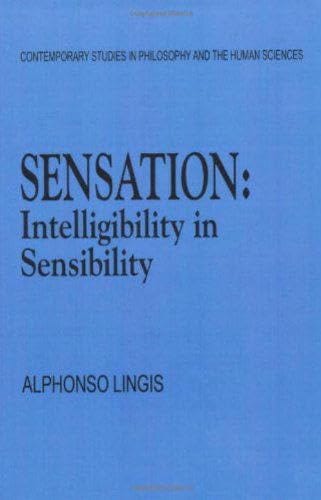
In his 1996 book, Sensation: Intelligibility in Sensibility (1996), he uses the bodybuilder – and steel – to propose that we perceive external elements through corresponding bodily substances, writing that ‘it is the hard and ferric substance of the bodybuilder’s musculature that knows the inner essence of the steel’. I will come back to this. But first, just a few more examples.
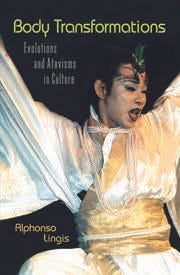
In his 2005 book, Body Transformations (2005), he reiterates that ‘bodybuilding is not a sport’ but rather an art akin to sculpture; one that is driven by the pure, sizzling pleasure of growing and feeling muscle groups expanding to their absolute limits. He concedes that the widespread moralistic distaste for bodybuilding ‘is right […] to find something suspect in the body-builder’s attitude and feelings’, because their physical exultation is not a moral satisfaction of effort and merit, but a celebration of the amoral universe of genetic chance. Elsewhere, under the subheading ‘Potlatch of Productive Body Parts’, Lingis describes ‘the supreme virile glamour of a bodybuilder’ as a luxury product.
The 2018 collection, The Alphonso Lingis Reader (Lingis 2018) reprints a few of Lingis’s key essays where these discussions reappear. Most appropriately, it includes ‘Orchids and Muscles’, and also ‘Faces, Idols, Fetishes’ (reprinted in Part IV: ‘Excess’), in which he discusses the exultant physical feeling that arises ‘after the morning workout pumping iron in the gym to muscle exhaustion’.
I will stop here. But notice that despite my earlier problematisation of the methodological institution or pillar of ‘the literature review’, I have pretty much given you one here – not of everything, but of something; some things. Despite what I said earlier, I know tha the literature review is an important part of any method, even if it’s only micro, or only a review of a small cluster, community or collection of texts.
Perhaps what the social science idea or ideal of the literature review misses is the fact that what you are looking for in the literature is not simply a ‘research gap’ but also and more importantly an explosion – the literature that blows your mind, stimulates you, moves you, changes you. Social science tries to expel excitement and captivation. But surely this is what drives us.
That’s what I found when I found Lingis. It was like finding a new exercise or approach that immediately changes things – changes me, or makes me see new possibilities, exciting ones, within my reach. The bodybuilder, the strength trainer, the martial artist – maybe others too, I don’t know – will recognise this effect and this experience, instantly. You try a new exercise or approach, and you feel it; and you go ‘holy shit – this changes everything’. You feel your body and mind vibrate, expand, tingle, grow; it’s like a rewiring, a retooling, an upgrade.
This is why we ‘review the literature’: not to look for a ‘gap’ but to generate an explosion.
Alphonso’s Gym
Speaking of methods, I don’t know what Lingis’s were, through and through. What is well known, of course, is that it was based in travel, in experiencing the new. In relation to his thinking about bodybuilding, I do not know if Lingis was a bodybuilder, or ever lifted weights. I saw him once or twice from afar at conferences and he certainly didn’t look like a bodybuilder. But that means nothing. Most people who identify as bodybuilders or who go to the gym for hypertrophy don’t look like bodybuilders. And there are even world level champion bodybuilders, male and female, who you would not recognise as bodybuilders while they are wearing outdoor clothes.
But I am fairly convinced that Lingis was in some captivated by Arnold Schwarzenegger. He discusses Schwarzenegger, Pumping Iron, The Terminator, and Commando in a few places, such as the essays ‘Orchids and Muscles’ and ‘Lust’. In ‘Orchids and Muscles’, he uses Schwarzenegger to illustrate arguments about the biological atrophy of the human species, the rise of cybernetics, and the aesthetics of the male body. He also cites Kristeva’s analysis of the film Commando, noting how explicit the ‘hermaphroditic’ nature of bodybuilding becomes in the movie, which portrays Schwarzenegger ‘in happy domesticity, tender, caring, feeding his child’ without any maternal figure present.
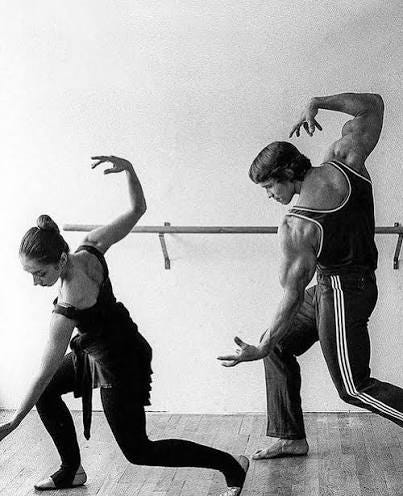
Most tellingly, he points out that ‘Schwarzenegger studied in a ballet studio how to walk with the grace of a prima donna’. This observation relates directly to an early scene in the epochal/evental docu-feature Pumping Iron. Similarly, in ‘Lust’, Lingis tries to quote directly from Schwarzenegger in Pumping Iron. He writes:
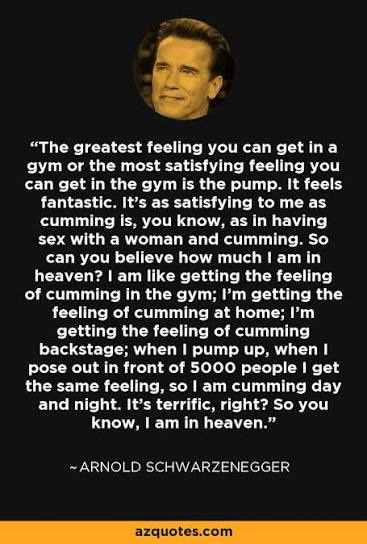
… to those who objected that most women really don’t find these Conan the Barbarian bodies sexy, and anyhow how could anyone get it up spending as much time in the gym hoisting barbells as you do, [Schwarzenegger] answered, ‘Pumping iron is better than humping a woman; I am coming in my whole body!’ The orgasm continues in the jacuzzi where the hard wires of the motor nerves dissolve into sweat and the pumped muscles float like masses of jelly.
Now, there are a few things to note here. First, the ostensible quotation from Schwarzenegger is really more of a slapdash paraphrase. He doesn’t actually say that. It’s actually rather surprising that Lingis and all of his editors let this supposed direct quotation stand, without comment or correction. Someone should have checked. Second, he doesn’t say these words – or anything like them – in response to a direct question posed by someone – certainly not someone whose voice is present within the diegesis or extra-diegetic sound of the documentary itself. And, third, we have the problem of how Schwarzenegger in the mid-seventies (Pumping Iron was filmed in 1975) could be answering a question about his body in Conan the Barbarian, which appeared in 1982.
So, there are, you might say, some methodological issues here. But also methodological insight. Lingis does not take literal and direct chronologically precise information from Schwarzenegger. Rather, he takes the ethos, the vibe, the atmosphere, and runs with it. This may be a literal misreading or misrepresentation of the situation, yet it really is not a misconstrual.
As such, we might say that Lingis translates a Schwarzenegger-informed understanding of bodybuilding into philosophy as a compelling basis for his critique of Heideggerian and Merleau-Pontian ‘utilitarianism’ in phenomenology. He advances on Heidegger, Merleau-Ponty and Levinas by recasting bodybuilding as a kind of exemplarily Deleuzean matter – indeed, an exemplary locus or chiasmus of affect as a methodological matter.

The Riddle of Steel
To explain what I mean by this, let’s go back to Arnold. Lingis mentions Conan the Barbarian in relation to muscles. However, key to Conan the Barbarian is not simply the matter of muscles. Muscles may be its gimmick. But key to Conan is steel. The film is defined philosophically – if not narratively, if not in terms of plot – by what Conan calls ‘the riddle of steel’. Now, to be clear, nothing in the plot hangs on the riddle of steel. But Conan himself is obsessed with it.
The riddle of steel is discussed three times in Conan the Barbarian. The first time is in the very first scene. The child Conan sits with his father who holds a sword, and who holds forth on the origins of steel. Man stole steel from the gods on the battlefield, he tells him. Hence: ‘The secret of steel has always carried with it a mystery. You must learn its riddle, Conan. You must learn its discipline. For no one – no one in this world can you trust. Not men, not women, not beasts. This you can trust’.
Conan’s father himself will soon be massacred along with the rest of Conan’s family and community by Thulsa Doom, who steals that very sword from Conan’s mother and uses it to behead her, before Conan’s young eyes.
In the second occurrence, Conan discusses his god Crom and Valhalla while preparing for battle. He says: ‘Crom is strong! If I die, I have to go before him, and he will ask me, “What is the riddle of steel?” If I don’t know it, he will cast me out of Valhalla and laugh at me’. Evidently, then, even by this stage, Conan does not have an adequate answer to what his father calls the ‘secret’ of steel, its ‘mystery’, and what Conan calls its ‘riddle’.
Finally, at the end of the film, Conan faces his lifelong enemy, Thulsa Doom. Doom recounts Conan’s crimes. In reply, Conan recounts Doom’s earlier crimes: ‘You killed my mother! You killed my father, you killed my people! You took my father’s sword!’
With this, Thulsa turns the conversation to the matter of steel. Conan asks if he is evoking the riddle. Doom says: ‘Yes! You know what it is, don’t you, boy? Steel isn’t strong, boy. Flesh is stronger! What is steel compared to the hand that wields it?’ He beckons to a girl on the cliff, who obeys his command and steps towards him, falling to her death. Then he says ‘That is strength, boy! That is power! The strength and power of flesh! What is steel, compared to the hand that wields it? Look at the strength in your body, the desire in your heart – I gave you this!’
Synthanatosis
Readers of Lingis may recognise the intertwinement of certain recurring themes and motifs here. In both ‘Orchids and Muscles’ and in his reflection on the life and death of Japanese literary giant Yukio Mishima, Lingis connects the muscles and steel: ‘the body builder confronts the steel’, he affirms.[1] This is important because, for Lingis, no cognitive or intellectual observation can grasp the true nature of materials. Rather: ‘it is the compacted ferric substance of the bodybuilder’s musculature that knows the inner essence of the steel’. For Lingis, the development of physical power requires a violent, exhausting labour against the metal. Lingis states that the bodybuilder ‘tears down, muscle system by muscle system, all the strength in his-her fibers and cells against the death of the steel’. It is only by knowing the effort it takes ‘to leave all his-her force on the dead inertia of the steel’ that new power and larger embodiment is born.
Thus, Lingis evokes symbiosis and what he calls ‘synthanatosis’. The relationship between the bodybuilder and their equipment is not a standard tool-use scenario, he observes. The bodybuilder’s weights do not relay force outward to accomplish a task. Rather, the lifter directly ‘confronts the steel, the opaque, inert mineralization of death, with all the body’s animate power in what is no contest but a process of symbiosis or synthanatosis’.
In this physical confrontation, once muscle failure is reached, the body’s living tissue ‘receives from the metal its properties’. Lingis details this metaphorical metallic transubstantiation explicitly: the ‘biceps become tempered flails’; the pectorals ‘become gearing’; the membrane of the abdomen becomes ‘a sheet of corrugated steel’; the knuckles become ‘brass’. Ultimately, the ‘luster of the muscle-contours acquires for the eye the opaque impenetrability of metal’.
Tracing Mishima’s discipline, Lingis notes that Mishima fitted his limbs and torso to the ‘inertia, opaque weight, mineral death of the steel’. Through this contact, his vital substance underwent a ‘transference of properties’, wherein the properties composing his excess musculature came directly from the steel, leaving him with ‘a body become ferric substance’.
Finally, Lingis argues that this relationship has a profound depersonalizing effect. The steel ‘does not only transfer its properties into the living tissue’, but ‘the homogeneity of the steel drives out the principle of individuality in the bodies that devote themselves to it’. By exhausting the flesh against the steel, the bodybuilder drives out personal, psychological eccentricities (such as a ‘concave faint-hearted chest’ or a ‘shifting eye’) to let the generic lines of the human animal emerge.
Holding
Despite this evocation of Thanatos, Lingis insists that bodybuilding is led by joy. Mishima was morose, but that does not mean that others need to be. Bodybuilding is productive, expansive. It is led by the hand clasping the steel, and the spiralling circles and lines of force and fields of intensities of reorientation and restabilisation that explode within and without the wielder. Chasing this intensity becomes the thing. I don’t know if it is in fact ‘joy’, as Lingis feels compelled to insist, for any number of reasons. But it is certainly the chasing of intensity, of affect. The bodybuilder, the strength trainer, the martial artist, and more, become the most intense and committed of scholars thanks to the immediate feedback mechanisms of micro and macro explosions, inspirations, excitations. And this is the point of the focus, the point of the research, the experimentation, the constant striving – the drive to be affected.
[1] Writing before the advent of Mr Olympia Dorian Yates, and the subsequent canonisation of Nautilus trailblazer Mike Mentzer, Lingis says, ‘no world-class body builder has trained on the Nautilus machinery’. This is because, he proposes, bodybuilders prefer to rely on atavistic, elemental equipment.

Comments
Post a Comment