Bicep Curls are for Arses
No Biceps, Please: We’re Functional
Is there a more maligned resistance exercise than the poor old biceps curl? It is held up as the very exemplar of so many frowned-upon things: it’s a vanity exercise, they say; an isolation exercise; an artificially biomechanically restricted movement; it’s an ego-movement; in focusing on the most immediately visually prominent arm muscle, it is often incorrectly taken as an indication of strength, even when all other muscle or strength development is absent; it’s a teenage boy movement. And so on.
There’s a lot to unpack here. I can’t go after it all. But let’s start with one of the most common claims, especially as it comes from the functional fitness community: the barbell curl is an isolation exercise, one that is hence to be contrasted negatively with the positive virtues of both compound weight lifting movements and more dynamic or ballistic athletic movements, such as, say, the barbell clean and press or the kettlebell swing or snatch.
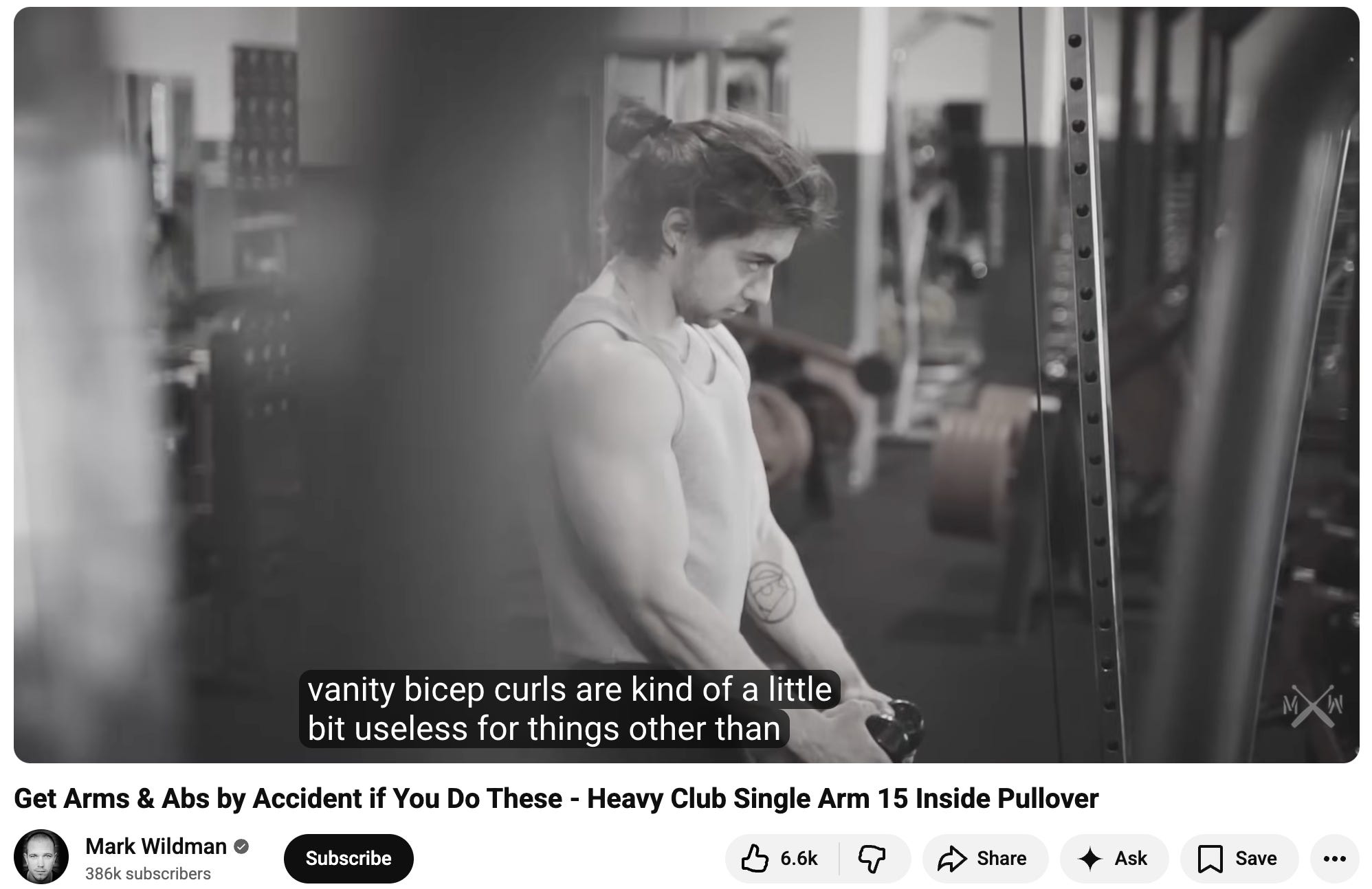
Circular strength influencer Mark Wildman focuses on kettlebell and heavy club exercises. I often talk about Wildman because I have watched many of his videos. I think he’s a very good online coach, and I have learned a great deal about how to do kettlebell and heavy club exercises from him.
In his YouTube videos, he often casually throws out such comments as this or that club or bell movement is ‘better than’ curls for developing biceps – and, crucially, that it will develop your biceps as a merely incidental added benefit to its primary athletic and core strength functions. For Wildman, if you perform this or that complex club or kettlebell movement, you will also develop big biceps, without doing any specific biceps exercises – and, crucially, it seems, without prioritising biceps development as your stated number one goal.
Outside of bodybuilding circles, this seems to be the only way that biceps development can be unambivalently legitimate: if it just happens without even trying. Trying to develop biceps, it seems, is in many circles something that is regarded as crass, naff, vain, or immature.
In the essay ‘Orchid and Muscles’, Alphonso Lingis proposes that bodybuilding is problematic to many minds, because it has all the hallmarks of a ‘cult’ rather than of a health-focused or sporting, and hence socially intelligible ‘enterprise’, such as that of a healthy mind in a healthy body (‘mens sana in corpore sano’). If it were about health, it would be easy to grasp. But, it is a cult that society cannot seem to decode, ‘know and integrate’.
The problematic character of bodybuilding is condensed metonymically into the barbell curl, and metaphorically or symbolically into the popping of the biceps. But, of course, problematic does not mean unappealing. In his account of why people find bodybuilders so disconcerting, Lingis continues:
The erotic eye, that which scouts the erotogenic terrain in the body of another – not the rolling surfaces of taut cutaneous membrane, but the spongy zone of susceptibility just beneath and the mucous membrane of the orifices – is disconcerted to run into packed thongs of drawn muscle. Not muscle that answers to the ungendered resistance of tools and implements, but specifically male and specifically female muscle alignments. One cannot resist feeling the very hardness of these muscles to be the badgering of the glands of lust – whole anatomies pumped like priapic erections, contracting poses and shifting with held violence from one pose to the next with the vaginal contractions of labor pains. They flaunt in the nose of an antiseptic consumer public leathery rutting odors; they gleam with oils that deviate the hold the inspecting eye fixes on these bodies into the sliding suctions of octopus eros.
Few people outside of those who are already well initiated and installed inside the cult of bodybuilding, with its precise aesthetic values, would say they wanted to have the body of a competitive bodybuilder. But many would be prepared to say that they wouldn’t be against developing more muscle, here or there, in their quest to improve themselves physically. This vague and euphemistic area is where ‘fitness’ influencers thrive.
Every Exercise is a Glute Exercise
As an online entrepreneur, Wildman seeks to appeal to as wide an audience as possible. Accordingly, he will make make concessions to those who may ‘also’ be biceps-interested (or bi-curious, so to speak). He also frequently emphasises that many functional kettlebell and club movements ‘should’ be regarded as ‘glute exercises’.
Clenching the glutes and core and ‘firing the lats’ are regular proprioceptive training cues that Wildman gives for any number of kettlebell and club exercises. Thus, he claims, many of these exercises are ‘glute’ exercises, especially such stables as kettlebell swings.
Against such glute clenching, hip-hinging, total body movements as kettlebell swings and snatches, the biceps curl seems to cut a sorry figure. Standing straight, focusing on the movement of one tiny but visually prominent muscle… isn’t that, at once, both excessive and insufficient?
But wait. When was the last time you actually tried to do this exercise?
I have recently added them into my routine, immediately following barbell bent over rows. Let me assure you, if any exercise is a glute exercise because it is clenched, then it is the strict standing straight bar barbell curl. If you are aspiring to do the movement properly, without cheating, then just about everything in your body needs to be fully clenched: glutes, abs/core, shoulders/traps, and even, I’m sure, calves, toes, perineum, jaw, tongue. You name it. Not cheating in the curl when using a decently weighted barbell is an immense effort. Ego exercise, indeed! It is exceptionally demanding. Resisting the egotistical desire to ‘cheat’ by introducing some swing of the body is extremely hard, and requires some serious total-body clenching.
In his club and kettlebell ‘instructionals’, Wildman frequently advocates for the values and virtues of the ‘core stabilisation’ required to maintain good upright posture while swinging weighted objects around. This is amply present in barbell curls. In fact, it feels to me that the effort of stabilisation in barbell curls is more extreme than in many kettlebell and club movements. You can do all sorts of lateral, angled, ‘throwing pattern’ and other movements with clubs or bells without even thinking about your glutes.
As someone who has trained for a long time, on and off, with all manner of resistance tools, including kettlebells and free weights, I feel inclined to argue that the strict, standing, straight-bar, barbell curl should be regarded as a demanding compound movement. I know this is counterintuitive, but bear with me. First, let’s revisit the question of its bad reputation.
That Dangerous Supplement
Why are biceps curls sometimes vilified? At the start, I suggested some reasons: it’s a vanity exercise; it’s an isolation exercise; it’s an artificially biomechanically restricted movement; it’s an ego-movement; in focusing on the most visually prominent arm muscle, it can be read incorrectly as an indication of strength, even when all other muscle or strength development is absent; it’s a teenage boy movement.
Translating such criticisms into slightly broader terms, one might say, they all point in one general direction: the barbell curl, with its singular emphasis on biceps development, is not easily translated into any broadly utilitarian, sporting, functional, or ‘heroic’ terms. This is Lingis’s starting point, in ‘Orchids and Muscles’. Here, let me start from the same kind of place, but cover some slightly different ground.
Everything about biceps points to posturing, preening, posing. We even say to children ‘show us your muscles’ and they try to pop their biceps. We say ‘ooh, wow, yes, great’. In other words, biceps are something for children. Seeking biceps is perhaps a pubescent rite of passage. But, here’s the rub. The first (‘show us your muscles’) shall be the last.
As something for children, it must therefore be something to grow out of.
Similarly, I have heard and read the following claim more than once: no one ‘needs’ to train arms. The arms get all the strength training they ‘need’ from their involvement in the more virtuous full body or compound exercises – the pushes and pulls of big movements.
The dominant ‘protestant ethic’ that constitutes the bedrock of Anglo-American values and virtues is quick to flip that which is not deemed necessary into something that is therefore negative, because ‘excessive’. The observation that direct (or ‘isolated’) arm training is not ‘necessary’, therefore easily becomes: we should not train arms directly.
Biceps Envy
In the 1923 essay ‘Some Psychical Consequences of the Anatomical Distinction Between the Sexes’, Freud painted a picture of the childhood realisation of sexual difference. Imagine a scenario such as little children playing in a sandpit. Playing naked in the sand, children eventually notice the presence or absence of the penis on their playmates and their selves. Freud notes this moment and reflects on it.
In the 1930s, Charles Atlas started advertising his muscle-building system via a series of adverts which painted a picture of the realisation of sexual impotence and potency, similarly, in a sandpit – this time, the beach.
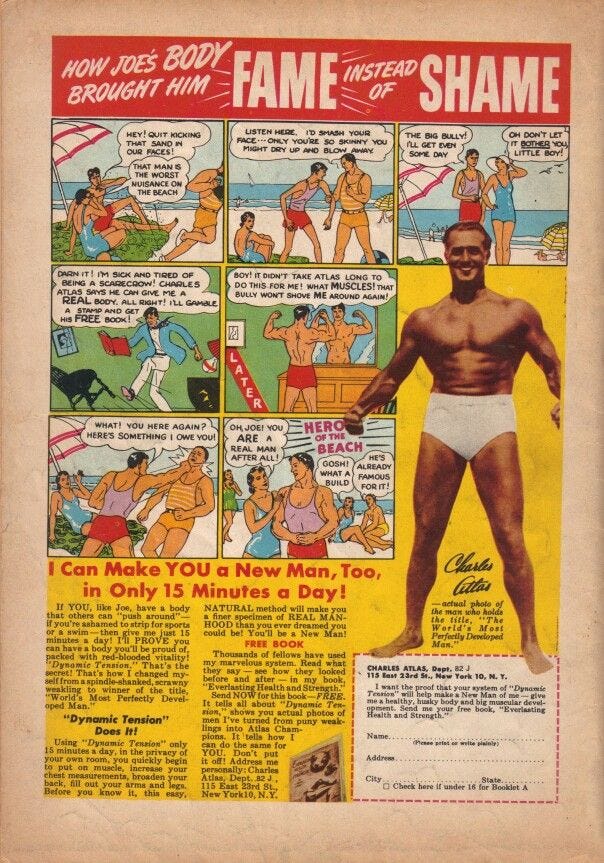
The difference between Freud’s reflection on noticing penises and Atlas’s depiction of noticing muscles is interesting. Freud writes:
There is an interesting contrast between the behaviour of the two sexes. In the analogous situation, when a little boy first catches sight of a girl’s genital region, he begins by showing irresolution and lack of interest; he sees nothing or disavows what he has seen, he softens it down or looks about for expedients for bringing it into line with his expectations. It is not until later, when some threat of castration has obtained a hold upon him, that the observation becomes important to him: if he then recollects or repeats it, it arouses a terrible storm of emotion in him and forces him to believe in the reality of the threat which he has hitherto laughed at. This combination of circumstances leads to two reactions, which may become fixed and will in that case, whether separately or together or in conjunction with other factors, permanently determine the boy’s relations to women: horror of the mutilated creature or triumph and contempt for her. These developments, however, belong to the future, though not to a very remote one.
A little girl behaves differently. She makes her judgement and her decision in a flash. She has seen it and knows that she is without it and wants to have it.
What Atlas suggests echoes and arguably inverts Freud. When the ‘little girl’ first notices biceps on the beach, she responds initially, at most, with curiosity. The ‘little boy’, however, sees them, sees he hasn’t got them, and he wants them.
Of course, the oedibiceps complex must be resolved. The phallic biceps flips easily into shame: an empty symbol of vanity, failed desire for plenitude, impostor, imposture.
Furthermore, adding Freud into the mix of our thinking is also something of a Pandora’s Box. It opens the door to an obligation for thinking about things like homoeroticism and its immediate sidekick, homophobia. Under heteronormative regimes, men should not dwell too much or too explicitly on the desire for the biceps of the Other, because, well, that must mean a kind of homosexual attraction, right?
Hence, we have to focus on other dimensions; more sublimated, so to speak: exercise needs to be for something – for something else – something clearly articulable and connected to wider social values. The problem is that the biceps and the biceps curl seem to be, in themselves, only for themselves, and hence only for narcissism and sexual display. They are like orchids, says Lingis.
Indeed, they are. But so, arguably, are they all.
The Curl Effect
Advocates of kettlebell training often evoke, in hushed tones, ‘the kettlebell effect’. This is sometimes called ‘the what the hell effect’. The claim is that after a period of time working on kettlebell exercises – especially the much-fetishized and I think overvalued kettlebell swing – when one goes back to other exercises or one’s sport, one sees surprising gains in strength or ability, even in movements one has not been training.
I have never experienced this. If anything, I go back to the gym after a period of kettlebell training, and I am objectively weaker and worse. The fact that kettlebell training so often seems to make you feel fitter and healthier and more full of energy is a different matter.
Might there be a biceps curl effect? The standing straight bar barbell biceps curl is undoubtedly a total body discipline. A mind-body workout. An ego-battle. Self-control. And are they really not functional? It seems the biceps curl is not regarded as functional primarily because the ideology of functional fitness has made it a whipping boy. It looks like isolation, so therefore it must be. But, given the dialectical logic of marketing, how long will it be before an influencer notices its opposite-ness to, say, kettlebell swings, and decides to market it as the missing piece of the functional puzzle?
Do I actually think this? Maybe not really. But one thing I do think is that the so-called ‘isolation’ aspect of the exercise is something of a misnomer. Rather than being isolated from the rest of the body, in order to make the biceps curl work, one must very consciously and deliberately keep the entire rest of the body in an isometric hold. If and when this slips, when we tire, and when cheating is required, the ‘cheat’ is actually something of a ‘hip hinge’.
Of course, while this is all true, I am not going to move from this observation to the illegitimate conclusion that the biceps curl is therefore a total body exercise that ‘hits’ or ‘works’ everything. That would be a bit much. But perhaps thinking about this as a proposition can help us to revaluate our relation to the frequent functional fitness claims that exercises like the kettlebell swing or kettlebell snatch are a total body workout. They are not.
Indeed, such exercises arguably even lack a precise focus. I mean, what does a swing or snatch actually exercise? At least the much-vilified biceps curl is clear about what it is actually for. In this one (communicative, semantic) sense at least, it is arguably more functional than many so-called functional fitness exercises.

Comments
Post a Comment