The Right Bag
Morning
The lengthening days, the fresh morning air and growing sense of firmness to the drying ground called me into my garden much more often in May. Life spills outside more in summer. This year, the puppy intensified all this – needing to be up and out at any hour of the day or night, and always waking up too early. The five-year-old Jack Russell amplified it: if the puppy’s awake, he’s awake. It must be morning. There’s no point me fighting against this now. I’m up.
I used to answer the call (or, to Alphonso Lingis, the ‘imperative’) of warming and brightening springtime mornings by going for early runs. Nowadays, I am much more inclined to hang something from the tree in the garden. My TRX, maybe, or Olympic rings, or one or another kind of punchbag. This year, I found several punchbags that I’d actually forgotten I owned. I thought I’d given all but one of my punchbags away last year. I’d forgotten about these ones.
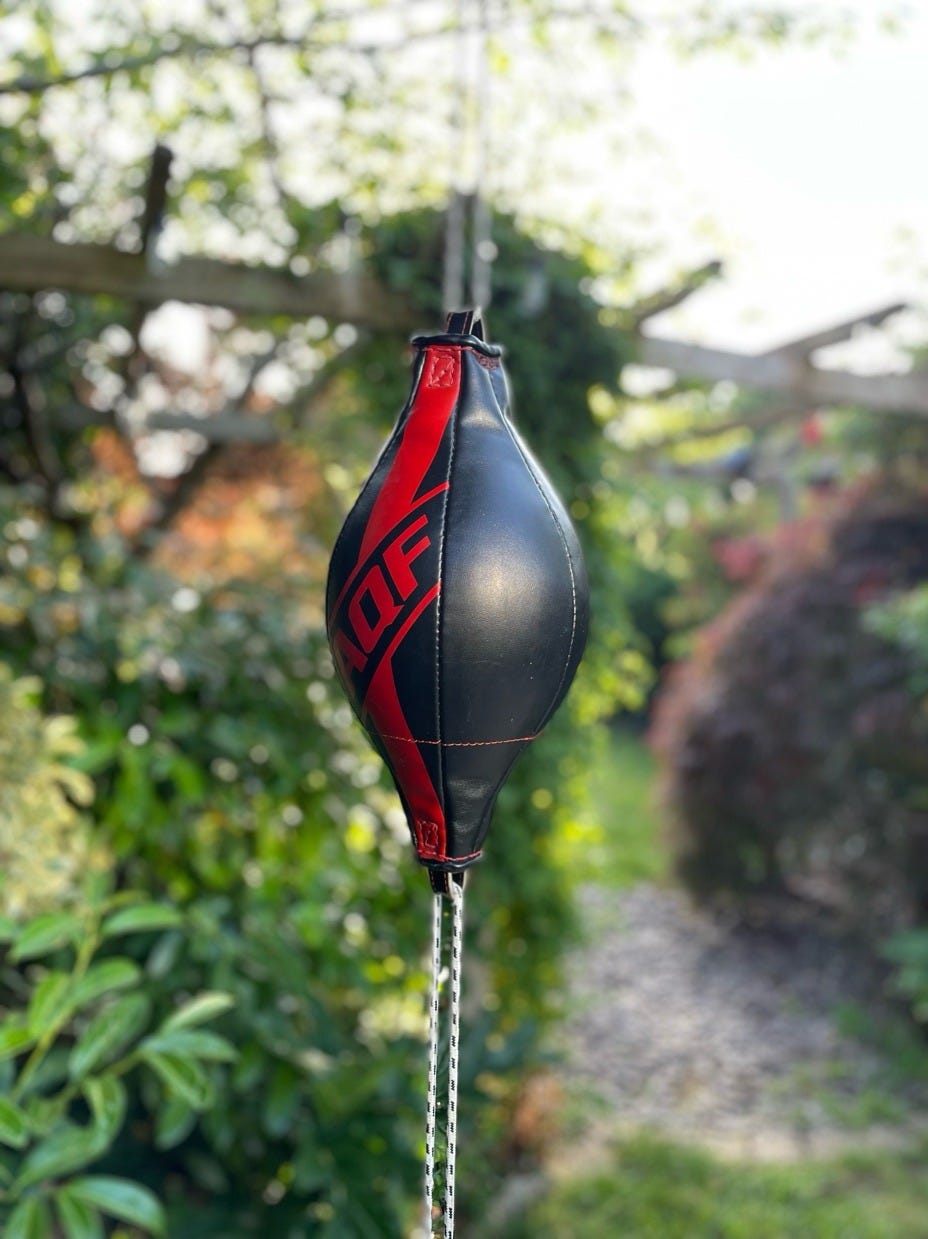
These are referred to by different names: ‘top and bottom bags’, ‘floor-ceiling bags’, or ‘double-end bags’. They are little speedballs, for training timing and accuracy. You pump them up with a bicycle pump, affix them by an elastic bungee to a hook on the ceiling, or an appropriate tree branch, and hook the other end to the floor – or, in my case, you anchor them using a 20kg weight plate with a small bar and a carabiner in it.
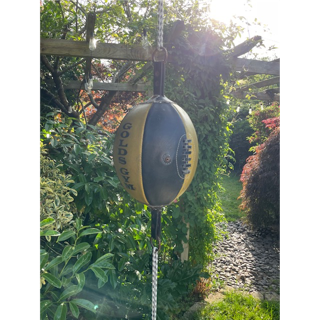
I took down my aqua bag from the tree – a beautiful invention: a small punchbag filled with water; so, it is heavy, but not too hard on the joints, with some ‘give’ when it; and it moves wonderfully. (As Deam Warriors noted, humans themselves are ‘bags of mostly water’, albeit with some pointy bits.) I replaced it with first one, then another double-end bag. After a few sessions, I settled on the smaller and faster of the two bags. Every third day or so for the last few weeks – in between a gym session and a rest day – I have been getting up early to train on it.
Sweet Nothings
The Professor in the Cage: Why Men Fight and Why We Like to Watch by Jonathan Gottschall is a terrible ‘evolution-babble’ book. However, there is one gem of an observation in it. Gottschall describes the experience of training on a heavy bag. A heavy bag is a large and long packed leather hanging bag. These come in various shapes and sizes. The ones we buy for our homes and gardens are like long five- or six-foot leather sausages, and they swing around a fair bit if you know how to hit well. A professional heavy bag in a boxing gym, however, may be considerably larger, with considerably less movement when hit.
Off-putting and painful on first encounter, heavy bags ultimately help develop strength and stamina. One needs some coaching, some decent hand protection, and some physical toughening to be able to get anything ‘out of’ attempting to work with a very heavy bag. They also develop some other things – not all of which are particularly helpful.
Gottschall describes working out on one during his MMA training. He notices a disjunct between the feeling and feedback given by the heavy bag and the actual experience of going to-to-toe in a sparring bout with a non-compliant opponent. As he notes, the satisfying thuds of punches on a heavy bag, with positive feedback rippling through the body, the ability to lean your entire body into the best positions for delivering solid punch after punch, all conspire to transform the punchbag into a kind of Siren on the rocks, which soon sings seductively into our ear: you’re really good at this.
Sensing
However, becoming ‘really good’ on the punchbag may develop some ‘transferrable skills’. But not many. Moreover, different punchbags give different feedback and show, tell, teach, or indeed fib about different things.
Across his oeuvre, Lingis argues that we elaborate ourselves within, on and in certain mediums, every time and always only working or walking along one or another ‘plane’. A certain type of light, a certain type of temperature or atmosphere, a certain sonic environment, the constraints and affordances of a physical location, the tools we have to hand, the forces bearing on our bodies and perceptions – all of these become, for us, one or another kind of ‘plane’ for our potential elaboration. Planes are localised, discontinuous and impermanent, but decisive.
I am only out in the garden at all because: light, birds, puppy, dog, dry, warm, desire. I choose one punchbag. I train. Straight punches: bam-bam, bam. Once my ‘eye’ is ‘in’, and I am attuned to the movements and speed, I move from straight to curved punches. Some of the curved ones miss. Such is the nature of the double-end bag. Apollo Creed steps out of the shadows in Rocky III as Rocky throws a huge haymaker at the double-end bag, and says: ‘that ain’t how you do it’. You’ve got to punch straight. That is the nature, the first lesson, the elementary directive of the double-end bag. If you can’t do this, you can’t do much with it. Your body has to learn how to throw crisp, sharp, straight punches.
Of course, level two: learn the rules, break the rules. Once you get into the movement and learn the rhythms and directions of the bag in response to your force, you can work some non-linear punches into your sequences. These are gratifying, because when you land them you know you have done something harder than simple entry-level straight jabs and crosses. A few fast jabs, a cross and then a hook (and then maybe another cross and an uppercut) is a satisfying combination, because the hook is coming at the bag in an arc, while the bag is zigzagging around ‘unpredictably’. But you can now ‘predict’ it. You ‘just know’ when and where to move. Your body knows, in a way that is way beyond linguistic or communicable thought or knowledge. It is sensory, dynamic.
Perception
The double-end bag encourages crispness, sharpness, conciseness of movement – of a certain kind. It encourages nimble footwork, efficient movement – of a certain kind. It encourages hands held high, short sharp movements, a curious dialogue inside your own shoulders and also your abdomen and hips about tightness, angles, twists and relaxedness. Still a world away from what your mind and body do when facing an opponent who is very keen to hit you, but perhaps as close as any training tool that I know of can bring you.
The heavy bag, by contrast, certainly encourages power, but it turns a blind eye to bumbling feet and widely swinging arms, to haymakers and low hands, to being too close or too far, to moving and standing in ways that would enable a savvy opponent clear entry points. The heavy bag is like an entirely deaf and blind opponent who does not notice your setup, movement, execution, but only responds to the impact and praises you for a heavy impact – wow, you’re really good at this!
I recall reading about experiments by Jakob von Uexküll – the theoretical biologist who was influential on the thought of philosophers like Gilles Deleuze, Felix Guattari and Peter Sloterdijk. In exploring perception, Uexküll would do things like place a spinning platform in front of, say, a snail. At a slow spinning rate, the snail would perceive that sometimes there were gaps and voids in front of it, and not proceed along its platform. However, at a certain velocity, those gaps became invisible and imperceptible to the snail, and it would proceed forward, thinking the surface ahead was firm. The heavy bag can do something like this to your perception. You can’t see the gaps.
I’m on my double-end bag one day, and I think ‘ok, how about some kicks?’ I did three years of taekwondo when I was in my 20s and much extra time after that doing kickboxing. I was once adept at some very fast and flashy high kicks. Of course, like any skill and any physical ability, it’s a bit like riding a bike. And, much like riding a bike, after several years away from the activity, one can expect a painful and disappointing gap between expectation and ability, at least at first.
I haven’t kicked anything for some time. I have not kicked high or often or with any seriousness or conviction or commitment for longer than that. I have tried to keep flexible. But there is flexible and there is flexible. Flexibility is one word for some very different things. I noticed decades ago that the flexibility provided by yoga practice was not the same as the flexibility developed by kicking arts, like taekwondo. Static stretching doesn’t have the same feel or same carry over into kicking as more ballistic stretching, or stretching for ballistics. To be good at kicking, you have to do lots of kicking. The stretching has to be kicking, the kicking has to be the stretching.
Then there are my injuries, and the rust and wear and tear that comes with age. The ankle I destroyed at 38 no longer enjoyed fluid between the bones. And after years of dry bone on bone action, the space meant to be full of lovely lubricating fluid is now full of what they call ‘post-traumatic arthritis’. It’s very temperamental. Plus, my age; my decades or micro and macro injury. Will my hips and lower back and ankle let me kick like I want to – like I remember, like I think I still can – today?
No. It turns out, not today. I’m trying to kick the double-end bag. It’s all wrong. I’m barely making the head-height target. The slaps of contact feel sloppy. My setup is weak. There is no bounce in my feet. My ankle does not want to help me with any kind of plyometric springiness. To make matters worse, my hips and back have formed a union against this, and have started a protest.
I give up. I start to tidy up. I loosen the ground anchor, and tuck the bag and elastics behind a branch of the tree. I decide to re-hang my aqua-bag. Not because I want to use it; just because it will last longer if it is hung rather than left lying around, warping out of shape under its own weight.
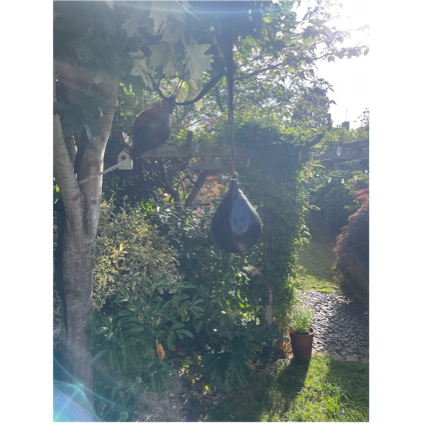
I hang it. Inspect it. I decide to throw a kick. It’s nice. Then another. It’s good. Then different kicks. A hook kick. A spinning back kick. Then combinations. Front kick, half-turning kick, turning kick. Crescent kick. Sidekick. Oh yes! All good. All great.
This bag is just right. The bag says: Yes! You know, you are really good at this? But I realise I am not objectively, neutrally, naturally, really good at this. It is the confluence of material factors. This is the right bag for this. The right plane. The right time.
‘My abilities’ are not universal. They are not everywhere and always. They only come to be actualised and actualisable in being elaborated along a localised plane, ‘in relation to’ or in a kind of interactive symbiosis with, the medium or technological apparatus. One punchbag said I can’t do flashy kicks, another bag said I can, and actually seems to help me do them.
As Alphonso Lingis argues at the end of his essay ‘Action with Things’:
The action to make things into means engages in things that make a means of the one who acts. The motorcycle commands the user to recon struct his posture, his musculature, his skin, his manual and mechanical skills, his imagination and his reason to serve it; his cycling makes him a biker. The land the Guatemalan Indian inhabits, the milpa he cultivates which demands the utmost of his rationality and leaves no indulgence for caprice and fantasies, are not means for him; he lives not only from them but for them, they are his dignity. The frijoles in baked-clay plates his wife lays out on the table for him and their children are not a means for the refurbishing of depleted body-cells in view of labor for ends beyond; in the repast their cares come to rest and: their laborious existence finds an hour of accomplishment.

Comments
Post a Comment