Sticks and Handles

Recently, I noticed Facebook was feeding me an advert for a stick. Yes. A stick. This was pitched as being some kind of miracle cure for bodily stiffness and aches. A medium to long-ish stick. You lean on it, twist, things like that. Magic.
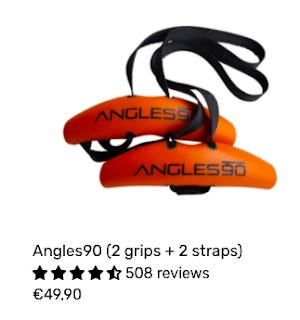
A while back, I recall being spammed with adverts for a new type of handle attachment for pull-up bars and suspension trainers. Yes: a handle. Apparently, the handles offer a choice between three different sorts of grip, and each of these grips enables a complete range of ever-changing ‘natural’ movement for the hands and arms during all kinds of exercises. This, the adverts assure me, mean certain crucial things: first, a reduction in stress on joints, second a reduction in injury, and third, massive potential gains in functional strength and/or muscle fibre stimulation.
This all sounds good to me. So, I looked at the price. €49.90. That’s just over £43. That is, around $60. For what they are, this seems a lot – especially as normal sling trainer handles already allow a huge range of options for grip, movement and variety. Moreover, substituting handles for a simple length of rope or cord offers even more variety and ‘natural’ movement. So, the price led me to hesitate, and I stood down from making a purchase.
Later that same day, a friend messaged me to tell me about his own recent pause before purchasing a gadget. Having a home gym in his garage that he berates himself for neglecting to use, he found himself about to purchase a training gadget, not to supplement or enrich his ongoing training, but in the hope that it would actually inspire him to go into his garage and train. We both laughed at the convoluted wishful thinking logic at play in this process – like buying clothes that are two sizes too small before you’ve even started a diet. But then we went on to reflect on the status of such supplements. I readily confessed that I am always entirely open to the possibility of purchasing a new gadget to enrich my exercise. I’m a sucker for a training gadget. But, sometimes this seems to be fuelled by an obscure quest to find some kind of holy grail – to find ‘The Product’ that would unlock ‘The Secret’ or ‘The Potential’. Thinking about it, almost every exercise or martial arts equipment purchase I have ever made has been fuelled by this fantasy: this time, this thing holds the key.
That Dangerous Supplement
The philosopher, Jacques Derrida once suggested that ‘supplements’ are often eyed with suspicion in Western philosophy (Derrida 1976; 2001). This is because they can morph from the status of secondary additional extras into primary focuses of attention, and thereby pervert an earlier system of values and proprieties. I have written about the supplement in relation to the ensemble or training, exercise and ritualistic or repeated practices that go into ‘martial arts’ before (Bowman 2017). A recent ‘abstract’ for one edition of Derrida’s classic essay, ‘that dangerous supplement’ puts it like this:
The dangerous supplement, which Jean-Jacques Rousseau calls a ‘fatal advantage’, is properly seductive; it leads desire away from the good path, makes it err far from natural ways, guides it toward its loss or fall and therefore it is a sort of lapsus or scandal. […] According to Rousseau, the negativity of evil will always have the form of supplementarity. Evil is exterior to nature, to what is by nature innocent and good. The supplement is both humanity’s good fortune and the origin of its perversion. [...] The supplement is the image and the representation of Nature. (‘Abstract’)
In the case of both my friend and me, each supplementary gadget didn’t so much threaten to drag us away from ‘the proper’. Rather, it mainly relied on the activation of some kind of magical or alchemical promise of a different (better!) future to come. For my friend, the purchase of one item seemed to promise to propel him off the couch and into his home gym. For me, the purchase of (yet another) supplementary add-on explicitly claimed to be able to catapult the exercises I am already doing into another dimension – a dimension defined by the (always and already mystificatory and mythological) word ‘gains’.
Scientific Magic
To me, this ‘promissory’ dimension ultimately raises interesting questions about the place of magic or enchantment in our lives. One might say ‘fantasy’ and ‘desire’, but these are such familiar terms for cultural analysis that they may have lost some of their… well, enchantment, or magic; and we may think we already know all there is to know about them. But, what about magic and enchantment? What do we know about them? Are they not relevant to our lives? Are they not present? Or do we just not realise when we are under their spell?
What about stretch-sticks and these supposedly super-technological handles? These are marketed through appeals to scientific innovation aligning with the ‘best’ ‘natural’ physiology of movement. Arthur C. Clarke once said ‘Any sufficiently advanced technology is indistinguishable from magic’. This can apply not only to complex cabalistic computer equipment or platforms, but also to nothing more complex than two lumps of moulded plastic and some nylon straps, or a stick, if it is marketed correctly.
The question is: how many times do we still fall into such structures of ‘logic’ or reasoning? How often do we truly believe that ‘modern science’ might – really, this time – be able to give us the key to ‘unlock our true potential’?


Comments
Post a Comment