Bodybuilding and/in/as Affect Studies
Actually Existing Alchemy
I recently returned to bodybuilding after about three decades away from it. Returning as a fully-grown academic, I couldn’t help but notice that it seemed to be a fertile field for affect studies; a field from which affect studies could learn a lot. Let me try to explain.
Bodybuilding is radically materialist and embodied. It is techno- and ethico-physical. It is disruptive, transformative. You’ve heard of ‘OOO’? Well, bodybuilding is ‘AAA’…
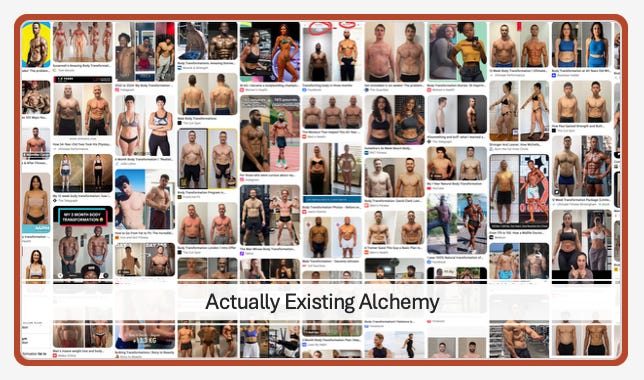
… Actually Existing Alchemy. It is transmogrification through excess: ‘too much’ generates ‘even more’. Competitive bodybuilding is its pinnacle. According to Stephen Moore, this touches the auto-deconstruction of hetero/cis norms and binaries; the transvaluation of normative gender values, via the forced expansion of their logic to the point of failure. Or, Alphonso Lingis argued: bodybuilders are hermaphrodites.
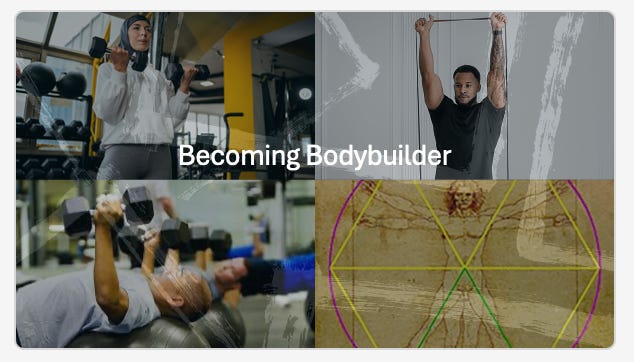
Becoming Bodybuilder
You probably already know the basics of bodybuilding’s alchemical magic. They call it ‘progressive resistance training’. And I bet most of you have tried it. Which makes you a bodybuilder – or becoming bodybuilder. The bodybuilder is anyone who repeatedly pumps their pecs and bis with bells and bars; activates their core with a TRX; presses, pushes or chins themselves up; burns their quads with wall sits, perseveres through the pain of planks, or stretches into a Da Vinci-like ‘Vitruvian Man’ inside an elastic resistance band. This has been most of us, at least once.

Average Joe’s and Globo-Gym
At one end of the spectrum are Average Joes who vaguely want to get a bit fitter. At the other end – or so many cultural theorists would seem to want us to believe – are Globo-Gym-style ideological dupes, who self-optimise, protein-max, live through their Fitbits, maybe take PEDs.
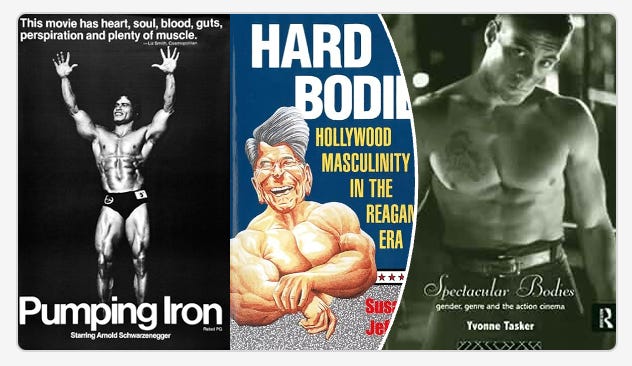
These are Patrick Bateman ‘American Psychos’, 1980s Hollywood action throwbacks, Andrew Tates, Joe Rogans, RFK Juniors, and worse. A genre of cultural theory, from Baudrillard and Eco to Stuart Hall and more, would have you think that the moment you look in the mirror and say, ‘right, that’s it, I’m busting out that old bullworker’, then ideology has you – that you are immediately entrapped by an evil ideology.[1]

The Joy of Flex
However, according to Alphonso Lingis, the first entrapment one risks when starting strength exercise is not the handcuffs and manacles of ideology, but rather the octopus tentacle caresses of pure joy. This joy, argues Lingis, bubbles up from the depths and boils down to a delight in the increase of one’s agency. It is joy found in a rekindled relationship with the alterity of one’s own body. Of course, there will inevitably be other forms of capture waiting in the wings: all practices have discursive scaffolding, and here there be ideological monsters.
But encountering strength training is first and foremost a pre-personal encounter with one’s own agency. Some will delight in detecting here the route to one’s own increase, one’s intensification.
Effort and Event
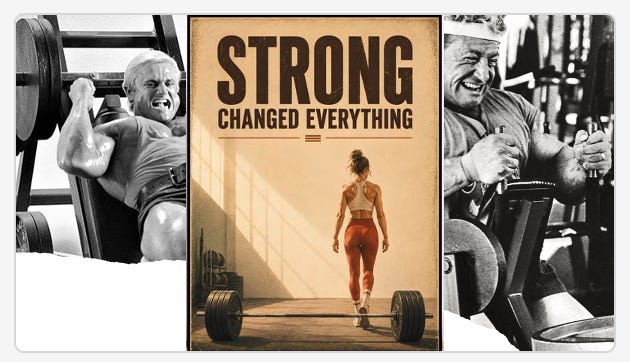
It is the exposure of self to something real. As Lingis notes, seriousness is weighty. The weighty is serious. From Aristotle on, the real has often been regarded as that which resists. Bodybuilder, strength trainer, and Average Joe, move the resisting agency of the real in ways that draw the emergent lines of the outer limits of their own agency into visibility, or palpability. The bodybuilder seeks the horizon, or the pit, or the orbit of what is called ‘failure’. Seeing failure means success. It means learning where the limit was, at that moment, and nudging it, affecting it.
The point at which our strength event horizon comes into view is something I personally experience synaesthetically as a kind of dilation and contraction/explosion of light, akin to the Millennium Falcon going into hyperspace in Star Wars.

There is a kind of white light dilation and contraction in my head, and anguish in my body. To get near to that horizon requires one thing: effort. Sustained, repeated, regularised, disciplined effort. There is no increase without effort.
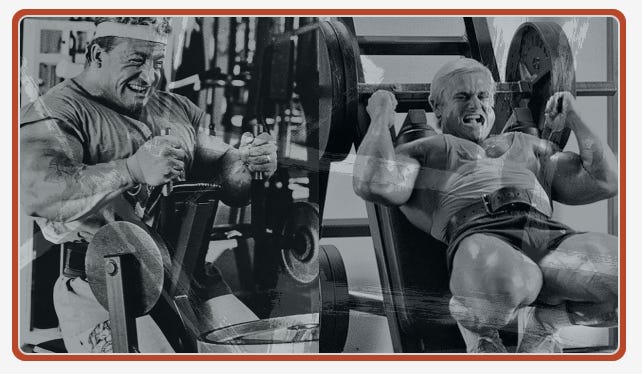
However, not all bodybuilding methods insist on excesses of effort. The infamous max-effort ‘heavy duty’ paradigm of Mike Mentzer or Dorian Yates, or the mammoth protracted self-torture approach of Tom Platz, are not the only approaches.
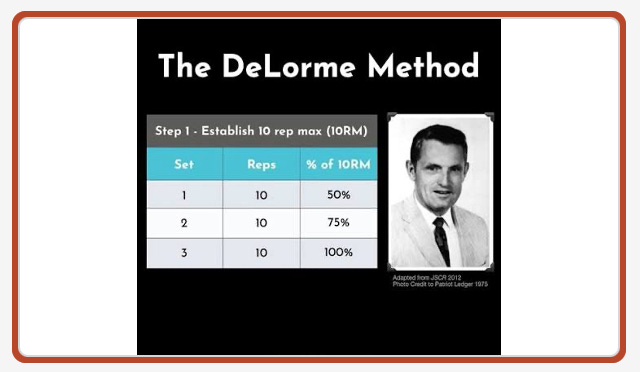
The original scientific studies of strength and hypertrophy in the 1940s used three moderate sets of ten reps per muscle group. A light set, a heavier set, a heaviest set. No screaming or thrashing about. Warm up; get into the groove; push it a little bit; then done. As long as there is some effort and incremental increase over time, your body will change.
However, even when avoiding extreme effort, over time one’s ability to generate intensity grows.[2] With this, a new relation to pain emerges. You go deeper into the difficulty of a set. You don’t panic in emergent pain. In fact, what a beginner might experience as pain, a more advanced trainer may feel as pleasure.[3]
Anguish
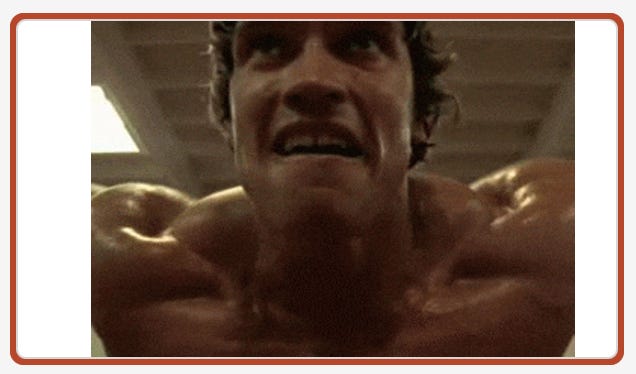
I just used the word anguish. I believe it’s an appropriate word to describe what lies in wait during an intense set. A hard set, both for a beginner and for the most advanced bodybuilder stimulates a sensation that can grow to feel all-encompassing, as the weight draws a specific muscle into consciousness. Such presence has long been associated with pain. Existentialists, phenomenologists, and, again, Alphonso Lingis, have all equated searing, world-imploding pain with presence. A hard set produces precisely this kind of presence: muscular pain and anguish.
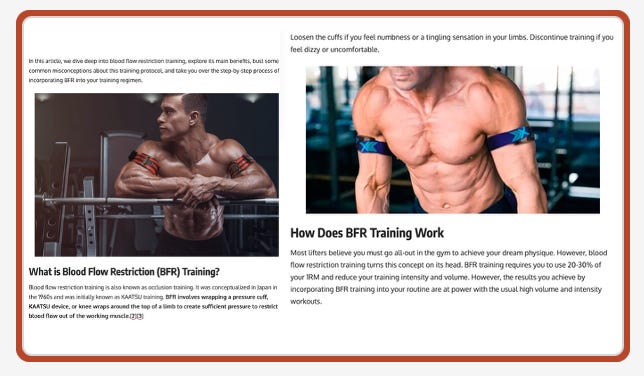
The etymological range of this word connects it directly with pain caused by constriction.[4] It shares a root with anger and angst. We might read all of these in the strained faces, grunts and screams of hard-training bodybuilders. Today, some people use tourniquets to trap blood within a muscle while training. And, of course, Arnold famously described the pump as a kind of auto-erotic limb-asphyxiation orgasm.
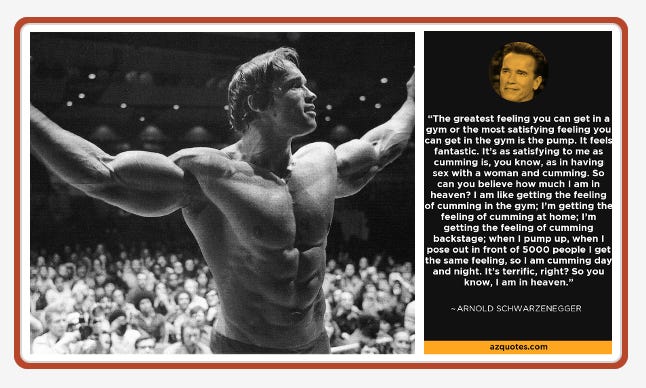
As an aside: a pump is not necessary for hypertrophy, nor for a good workout. Arnold’s ‘as good as cumming’, ‘cumming in the gym’, and ‘cumming all the time’ comments in 1977’s Pumping Iron have, I think, misdirected discourse about bodybuilding for half a century now. The pump is one possible experience; but it is neither essential nor primary. Intensity, however, and with that the anguish of effort, is non-negotiable.
Why am I saying this?

Shame
Sylvan Tompkins argued that a primary affect is shame. Tomkins said that Darwin claimed this. Others have said that Darwin never claimed this. If so, then perhaps Tompkins’s claim of the primacy of shame is built on sand. Which changes things, right? – even if placing shame front and centre has produced some fantastic work, such as that of Eve Kosofsky-Sedgwick, for instance. But if the primacy of shame is not compulsory, then maybe we can now swap shame for something else? So, what happens if we move anguish front and centre instead?
Lacan insisted that anguish is the only affect that does not lie. Everything else can be about something else. But anguish is an encounter with the lack of lack – the unbearable weight of trying to bear the full weight of full presence.
So, if shame is not compulsory, maybe could we move things around – forget shame and feel neither angst nor anger about trying out anguish as a primary affect? I mean, if we move away from shame, and move instead to the ‘lack of lack’, or pain of full presence, then mightn’t that help affect studies move even further away from another Oedipal conceptual trap? (We might even thank Lacan for this…)
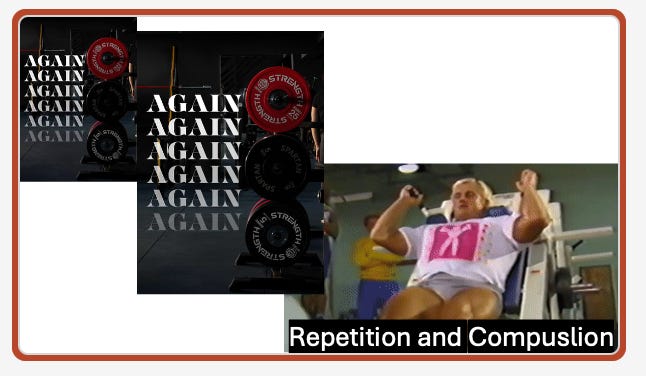
Repetition and Compulsion
To help decide, let’s ask ourselves: what would the bodybuilders do?
Some would never risk changing things around. Others insist on the necessity of switching things around periodically, in order to keep stimulating growth. These are two different approaches to maintaining fidelity to the effective production of affect. Indeed, it is a paralogical field: there are many methods; some are science, most are arts.[5] But what all approaches to bodybuilding hold in common – all the arts, sciences, disciplines, esotericisms, and devotional rituals of bodybuilding – is the centrality (or corticality) of repetition. Reps.
Repetition is the central component of what Sloterdijk calls anthropotechnics – the making and remaking through repeated effort of the ever-improved human.
Of course, repetition is really reiteration. As Derrida taught us, there is no pure repetition, even at the best of times. And repeated attempts to exceed or differ productively from previous iterations is anything but a desire to repeat. Compulsion is there, certainly. But anthropotechnic repetitions are striving repetitions; repetitions full of effort and desire to exceed their former selves. More weight, more sets, more reps – more intensity.
Structure of Feeling Management
What all bodybuilding has in common, then, is an apparently eternal return. If not every day, then at least twice a week; a rhythmic returning. But the return is never the same. (You can never step into the same set twice.) Rather, bodybuilders seek reliable paths to a shifting limit – viable veins to coax into new visibility something that is actually a new limit, each time. How much will I lift today? How many sets? How many reps? Let’s see how this set feels today. Feels good today, feel strong; let’s go heavier. (Or the opposite.) This is a shifting limit. It comes into existence in an atmosphere. A structure of feeling is sought. The quest to identify factors that produce the sweet spot is ongoing. Rituals grow, routines emerge organically, of what worked before and might work again. Superstitions, charms, fetishes and rituals seek to produce the perfect conditions.[6] A whole optimisation discourse and attendant industry exists.
Vanishing Points
Clearly, bodybuilding is driven by and for affects. The feel of the metal, the angle of the bench, the smell of the air, the sounds – all matter. The environment needs to be exactly right. It needs to feel like we cannot feel it; like it does not intrude – an ‘invisibilising’ environment, we might say, or – echoing phenomenologist Drew Leder – an absent environment. All the while, the bodybuilder – obsessively, lovingly, aesthetically, scientifically, dotingly, desirously, compulsively – searches for affects. Sensations and sensory information are scoured for signs of change. If they feel wrong, the bodybuilder works proactively to change them, to restructure the feeling. The more serious the bodybuilder, the more the entirety of their life is a pulsating, palpating somaesthetic choreography; from the precise mapping of the hand that grasps the resistant material, the foot that pushes, the spinal alignment, gluteal tension, shoulder positioning; the rhetoric of the breath and poetry of the part-objects of grunts and gasps; to the timing, weighing and measuring of food and supplements; the evaluations of the aches, the development of arcane personal laws of interpreting what is seen in the mirror, what is being said by the scales or the quality of sleep or the tension of one’s own t-shirt; like a Roman priest evaluating and interpreting animal entrails in incessant auguries.
Mantras of Philosophy
But, given this massive range, what do we even mean by ‘affect’? Cue the mantra, right? All together now: ‘The capacity to affect and be affected’. But, wait: this is neither a definition nor a description. In fact, at face value, it is little more than a tautology. To regard the phrase ‘capacity to affect and be affected’ is if it has the status of definition or indicates understanding does a disservice to definition and (I think) understanding. Both definition and understanding require other terms. Certainly, this mantra has never helped me much.
Of course, I have applied it as a formula – always asking ‘in what ways does this situation involve both the capacity to affect and be affected?’ But I have rarely found this formula to be productive. Certainly, we can all see progressive resistance weight training’s power to affect or alter the trainee. But what about the other bit? How does the trainee affect the weights? Other than thinking about conversions of potential into kinetic energy, I can’t find a huge amount of action here. So, I’m left wanting more.
The Riddle of Steel
That is why, I have recently been seeking new ways of, if not defining, then at least conjuring or provoking affect. To do so, I invent aphorisms or riddles. ‘Definition’ is valuable; but it is not the be-all and end-all. Definition is just the provisional tethering of something into semantic position. What provokes more movement in me, I find, is producing the proverb or provocation of a concept; the appropriate conundrum or aphorism; the kind of thing you might put inside inverted commas and write ‘Discuss’ after – to try to expand students’ minds. To try to expand my own thinking, I play with proverbs, aphorisms and riddles, rather than definitions. I try to forge a folklorish ‘wisdom formulation’ of any concept I’m working with.
Recently I have been exploring whether affect might be figured as the unintentional giving and receiving of contraband. Under this conjuration, the ‘affect’ of or from something or someone on me is what I receive as (or as if) passed on by it or them that wasn’t really its or theirs to give. And vice versa: I give to you something that was never really mine. You might say: a gift given by a giver that never possessed it to a receiver that never really wanted exactly that. This is not yet an aphorism. It would be easier and more elegant to simplify it into something like: affect is ‘to give what one does not have to someone who does not want it’.
But there are two reasons to pause before doing this. The first is that this would reduce affect to something that flows solely between people. And that’s no good, because it excludes the material world, including my weights. And the second is that the phrase ‘to give what one does not have to someone who does not want it’ is already taken – it being, of course, Jacques Lacan’s formulation about love.
Give and Take
Of course, loving and giving are rarely divorced from discussions of affect. But let’s not rush there too fast. Instead, let’s expand our almost-aphorism beyond these two limiting factors of its humanism and its Lacanian use. Does it work for bodybuilding?
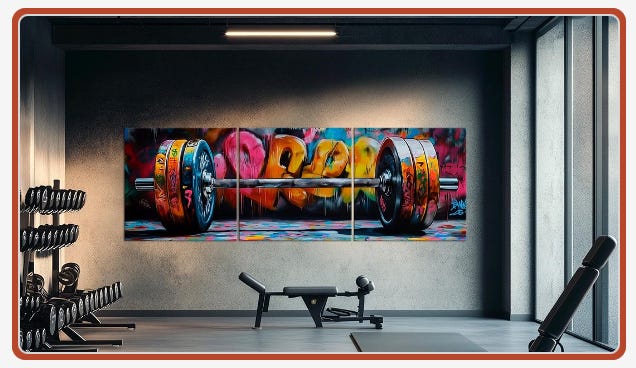
The only things that the iron, steel, elastic, moulded plastic, leverage apparatus, cables and pulleys of bodybuilding tools can really ‘give’ is their resistance; along with their feel, their noise, their smell, their temperature, their taste. Nonetheless, they also – indeed, they primarily – give us things that are not theirs: problems, challenges, tasks, jobs, discomfort, fatigue: things we don’t really want. Of course, by the same token, we are also giving such things to them – things they are highly unlikely to want.
So we are given (or take) things by (or from) these things that are not theirs. Our tools don’t have any of the following, yet we take them: cellular, metabolic micro-trauma, hormetic stress, psychological distress, identity crises, even ethical ideas or ideals. Self-knowledge, skills. Strange satisfactions. From there, different elements of our bodies take further things, things that were also not directly given: impetus, stimulus, signals to repair and change in light of the experience, to better prepare for any subsequent similar experience. Hunger. For, the body does not want change. The body wants stasis. It is our fantasy and desire that wants change. It is our desire for what Lauren Berlant in Cruel Optimism calls ‘the change that’s gonna come’. This is what sustains the pain and anguish we get from subjecting ourselves to the cruel tutelage of the tools.

In this sustenance, our desire for a fantasised new body, a fantasised new self, must of necessity convert to the production of drive, repetition compulsions, if the whole endeavour is not to fizzle out, to deflate.
Drive
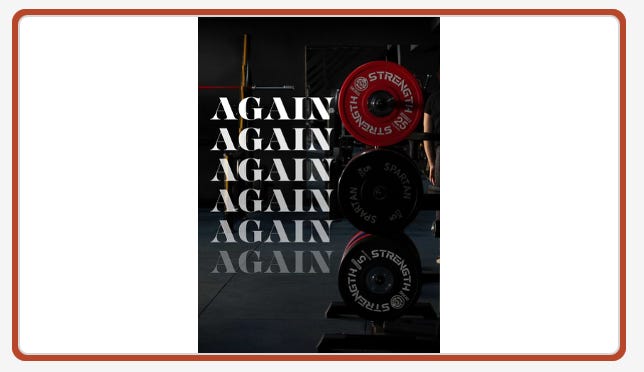
We know the bodybuilder is driven. We just don’t know why. Some drive drives them, repeatedly, to the gym. This drive is like a sex drive or ambition-drive. But it is also like ‘going for a drive’ on an aimless weekend – open-ended, for its own sake, for no clear sake. Being driven is being compelled to repeat – but more – and deriving pleasure from it.
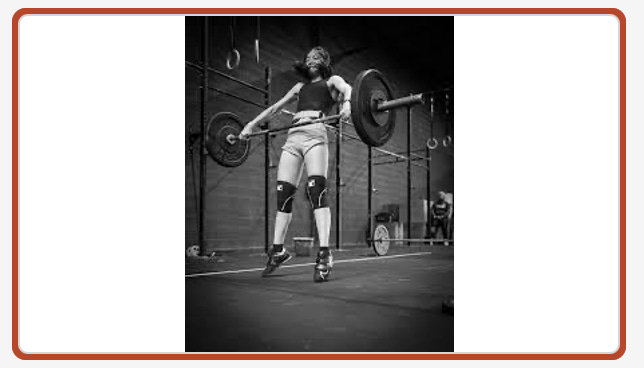
The pleasure is in the circuit, in the repeating, in the repetitions – like going for a nice drive. Lingis notes, we all have abilities to convert pain into pleasure, terror into joy, suffering into satisfaction. We play chase, fun fight, compete. We can trudge for hours up cold wet hillsides and call it a nice day out. We can do burpees until we think our heart will explode and our lungs will shear and tear apart and call it great.

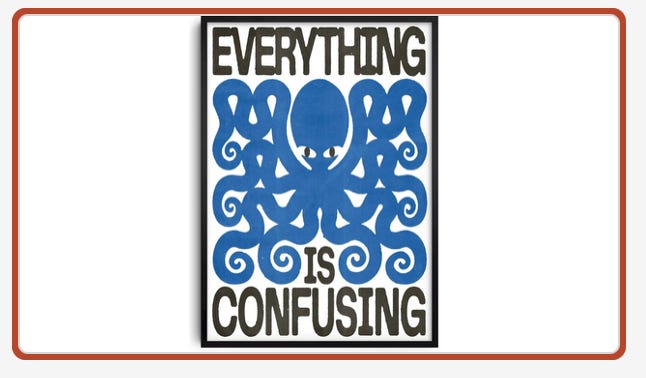
This is the alchemy of affect. Affect is actually existing alchemy. As Lingis repeatedly paints it, the bodybuilders take from the steel – steal what the steel doesn’t have – and convert that into the purest most desirable, sensual spectacle; the sparkling evanescent glory of a momentous but only ever momentary victory over both the recent past and ultimate destiny. Of course, it also fragments like fireworks as their sparkles fall away after their big bang; their octopus arms twinkling away and scattering to the winds and the pull of gravity. But we too can feel that burn, and learn that alchemy – or another – and take from bodybuilding what it doesn’t really have to give, including what we don’t want from it.
[1] But would such post-Marxist ideology critics leap into this kind of conclusion if we looked ourselves in our mediated eye one day and decided ‘right, that’s it, I’m learning Tango’ – or French, or philosophy, or about the life and work of Frida Kahlo?
[2] Strength is neurological. Strength acquisition is, in many respects, little more or other than skill acquisition. They say that the beginner can only recruit around 30% of their muscular strength. The first gains in strength are actually gains in skill: the intensification and increase of ability, of agency.
[3] Some approaches cultivate the ability to battle through pain (CrossFit, kettlebell sport, stuff like that). But these are not hypertrophy-focused. Pain is a gauge and a tool that is used differently and has a status and role that is utterly different even in cognate fields.
[4] Especially of the throat – so I wish I had thought about this back when I was writing about BJJ.
[5] Most commonly, bodybuilding is sense-discipline more than science, although there are those who would stamp SCIENCE in capital letters onto the entire endeavour; and who would subordinate almost all sensory feedback (other than injury) to the numbers.
[6] But there are more influencing and determining factors in heaven and earth than are dreamt of in all these philosophies. Yet, I know, if I train by myself, alone, in a stinky environment, with shitty equipment, after a bad night’s sleep, after a transatlantic flight or a family crisis or financial stress, feeling hungry, too hot or too cold, in the wrong clothes, I will very probably not be as strong as if I train in my favourite place, with my favourite crowd or securely alone, after several great nights’ sleep, regular good food; or if I love the track that has just come on; or if think a key thought in just the right way at just the right time.

Comments
Post a Comment