Octopus Ego
It’s early. I let the dog out into the garden, stand and wait, looking around for the first time that day at the glistening lawn and plants, dripping wet after much needed rain, waking up. It’s definitely autumn now, a gorgeous morning. I feel the chill. I can see my breath. Wearing nothing more substantial than a t-shirt in the doorway, I fold my right arm across my torso, hugging myself, automatically then resting my left elbow on my right hand, as I lean against the door frame. My left hand goes reflexively to my chin – thumb on chin, finger on lips; a bit like Rodin’s ‘Thinker’, I suppose – although for me it is always also a classic bouncer defensive pose (key areas covered, hands in good places, ready to act in defence or offence).
I hugged myself with my right arm for reasons of warmth and comfort; but, without my conscious intention, my right hand instantly inspects the flesh it can feel through my t-shirt. It reads this area of my body (and by extension all the rest of it) without moving at all, and entirely without me asking it to. It is like some foreign body scanning me, like a fucking Fitbit, but a living one, one that behaves like an alien tentacle, feeling me, judging my body, sending messages from this contact zone to… where? Somewhere else. It’s as if I am eavesdropping on private messages flowing on a radio wave; as if it’s nothing to do with me, yet it’s taking place on a frequency that I just happen to be able to hear.
As the tentacles carry out their audit of me, on me, without me, I start thinking about bodybuilding, and my relationship to it. The audibility to me of the audit of me that is taking place on me is what prompts this line of thinking. Last night I had been toying with the idea of writing a piece about the representations of bodybuilders in films and documentaries. My starting point: bodybuilders are often depicted as screwed up. And yet, resistance training is having a cultural moment. It is celebrated everywhere. So, there’s a kind of disconnect here; and to me the question of the limit emerges; the question of where culture draws the line between a healthy or commendable interest in what is currently deemed beneficial (resistance training), and where that flips over beyond the limits of acceptability into the supposed ‘too much’ or ‘for too long’ that Freud regarded as characteristic of perversions or fetishes in Three Essays on Sexuality. When does culturally acceptable resistance training flip over into something which that very same culture deems perverse?
I think my dad approved of my weightlifting, when I was a young teen. But the pictures of bodybuilders on my bedroom walls? That’s less likely. And the day we were sitting around the table and my mother asked what I was doing with my hands… I had my arms folded and I was, as ever, squeezing and massaging the fat around my waist that so preoccupied me, as if I could perhaps will it away or massage it away – my dad reacted as if I had just been caught masturbating. He was outraged.
I often recall this, as I do now, as my right hand rests across my left ribs, as it automatically judges me, like a butcher judging a cut of meat, or an alien sending messages to the mothership about all the ways in which I am lacking. My fingers lie in the zone of the serratus muscle group; the ends of my fingertips are almost reaching around as far as the outermost reaches of the latissimus dorsi. Across the front of my body, my right forearm lies across the top of my rectus abdominis. It too is sensing and sending reports. I feel its message: belly not sticking out at the moment: good.
Yet I know this is only temporary. I haven’t eaten since yesterday. Still, my forearm octopus tentacle is pleased. I also sense my solar plexus. This time, it is my torso itself, not the tentacle, that is doing the feeling, sending the message. In the same pressure, from the same forearm/tentacle, I can also feel the horizontal surgical scar a few inches below the solar plexus; the scar from the repair of an epigastric hernia. This has since been a zone of concern for me for many years now, one that must be defended at all times. If I feel pressure there, I often feel fear; a memory of pain, living there.
My hand and arm, along with my solar plexus and hernia scar feed back and forth to each other about at least three of my minor neuroses, all at the same time: how much fat is there? How firm or taut are the muscles? Can I feel pain in my hernia scar or solar plexus? These are some of my constant preoccupations.
Yet, they are not pessimistic. The bodybuilder in me knows that my body is never finished. It is always moving, either in the right direction or the wrong direction. Hypertrophy or atrophy, stronger or weaker, fatter or thinner, more flexible or less. The bodybuilder is always deeply optimistic, passionately attached to the idea of progress. Any flex of their own muscle to them never reveals what that muscle is, what its qualities are, its enduring identity; it only indicates the general direction of movement. Is this muscle moving in the right direction or not? A muscle flex and self-evaluation always also calls up an entire narrative about its current state.
Freud argued that the ego is fundamentally a matter of embodiment, that it develops from sensations and perceptions of the body, especially from the body’s surface – its ‘skin’, as people have come to say – rather than existing as a purely mental or disembodied self. In The Ego and the Id, he writes that the ego is ‘first and foremost a bodily ego’. But the body is not just one thing, not one region or unified place. We get constant localised, regionalised, fragmented bodily ego cues from sensations, such as touch, especially self-touch. The ego derives from bodily sensations, ‘chiefly from those springing from the surface of the body’.
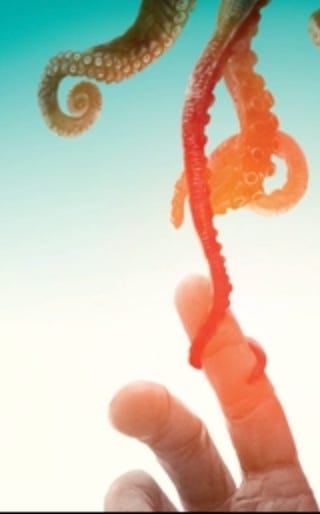
Phenomenologists from Husserl onwards have reflected on the touching/being-touched relation that arises when one of your hands touches your other hand. One is the touching and the other is the touched, so they say. Like Merleau-Ponty, I am never entirely sure which part of me is doing the touching and which part is doing the being touched. Rather, for me, the effect at the interface of one part of my body touching another seems to generate a kind of intimate alterity, as ‘something’ whose messages I can hear in my mind arises in the contact zone. I have come to think of this as an octopus, or at least octopus-like; something that emerges, as if from the outside, at the interface of the contact zones, that ‘reads me’ in terms that are not simply my own. In my mind are octopuses from Hokusai to The Matrix.
For both Freud and Lacan, the body is colonised by signifiers, chopped up by signifying regions. The symptom is a word trapped in the body, so to speak. But the body is also an assemblage of affects, sensations. If I become aware of a muscle that feels taut, firm, alive, fully present – let’s say my bicep on a good day, as I fold my arms – then that feels good and that means good. Derrida talked of the economy of force and signification. If I can feel the force of my ‘self’ in a certain moment in a certain way, then that feels good and that means good. But if I then notice a muscle that feels flaccid, flabby, or not present enough – let’s say my calf on an average day, if I am sitting down, wearing shorts, and notice it – then that feels bad and that means bad. It is of course chicken and egg which came first, the meaning or the feeling; or more like a mushroom from its mycelium, or – to borrow a Lingisian image from Gabriela Méndez Cota – an octopus arising from the cerebral depths, an enigma of fear/desire, lust/loathing, that arises elementally.
I have always been like this, I always do this, I am always doing this, and it has been thus for as long as I can remember. Do you? Are you? When I fold my arms, my fingers immediately make judgements about my belly, my abdominals, my intercostals, my bodyfat. My biceps form judgements of my pectorals. The backs of my hands make further decisions, sometimes about my biceps, sometimes triceps, depending on position. Let’s not even get started with what happens if I catch my reflection in something. My sensing units – fingers, palms, knuckles, backs of hands, arms – and their counterparts, the muscles and fat or flimsiness of the torso and legs – become other, working for something other, outside of me. What they feel is other to them – it is merely good flesh and bad flesh, hard flesh and soft. These are my signifiers, my symptoms, I know; other symbolic orders are available. But I become other than my self twice over.
Liz Grosz uses the image of the Möbius strip to think about the body ego (Freud), or skin ego (Anzieu): that contact on the outside that immediately links it to both the heart of the inside and also the external social and cultural world of meanings and values. For me, my self-touch on my own body, through clothes or on bare skin, is always the exploration of a deeply turbulent semiotic terrain. It’s a bit like my own BBC Radio 4 Shipping Forecast on a bad day. Biceps: Fair to middling, tending towards good later. Belly? Bad. Calves, fucking awful. And so on. But the contact zone does not merely open a wormhole between most internal and most external; it also conjures up an entity doing the evaluation: my octopus ego.
The signifiers that crosscut me have changed with time. The imagined somaesthetics that animated me have evolved. When I was young, my mind was full of images of inflation and deflation. Good periods of training made me feel literally pumped up. Missing a few weeks felt like having a slow puncture, as I watched my muscles shrink. But nowadays, my mental imagery has started to shift somewhat into a rather different set of visual metaphors. One is the image of vanishing. I see myself vanishing, feel myself evaporating. My struggle is against vanishing.
The other image is fibrous: a fibrous, textile, textual metaphor. Fibres can and will loosen, become slack, or tighten, become taut. The former is what just happens as you age. The latter is the goal as you train. In my mind, slackness allows either absence or fat or both into the spaces between fibres, like sludge in the filter of a tumble dryer. I know I appropriated these images from something I read. I once read somewhere that as you age, spaces that may once have been owned and filled with muscle fibres become invaded and colonised by fat. So now, when I am working out, I am less inclined to imagine my muscles growing as to imagine them squeezing absence away, squeezing more presence into existence…
Some readers might read this situation as a plight: the plight of a totally captured body, a body overwhelmed by signifiers, a body tending towards body fascism, fattism, and the fascist life that so concerned such thinkers and activists as Deleuze, Guattari and Foucault. However, as Erin Manning noted in Politics of Touch, this kind of sensory attention can also be regarded as transforming the senses into prostheses of or supplements to the self, rather than the crafting of a supposedly unified and complete whole body. Perhaps my octopus ego is a kind of exbodied sense. Maybe it’s just my superego. My octopus teacher become my octopus examiner.
Still despite the relentlessly harsh character of the intercepted communiqués, the bodybuilder in me does not despair. The bodybuilder knows that the readings taken by my octopus ego are only ever readings of moments, of events, situations, brief stasis. As I stood there at the door, with my elongated frame, things felt pretty good. But I knew that reading was neither definitive nor enduring. Hours later, as I sit, typing this, hunched on a sofa, rounded back and comprehensively lounging, every time I take a break from typing, and fold my right arm across my body, all it feels are fields of fat, and my tentacles say that this is really bad. However, the bodybuilder in me is always optimistic: this is just a moment. What matters is movement, and its direction.

Comments
Post a Comment