Love Copy Edit
Yesterday, I returned to ‘We Mortals’ by Alphonso Lingis. I have two PDF versions of it, one from its publication in a philosophy journal in the very early 1990s and one from its subsequent appearance in one of Lingis’s books. It’s an old essay, and was presumably scanned and shared illegally at the very start of the scanning and sharing era. Which means it is shit quality. I have tried and failed several times to generate text recognition in these PDFs in order to copy and paste my favourite quotations. I might have succeeded were it not for the fact that both copies have twp columns of text, that no program seems able to recognise as columns.
Why does this matter?
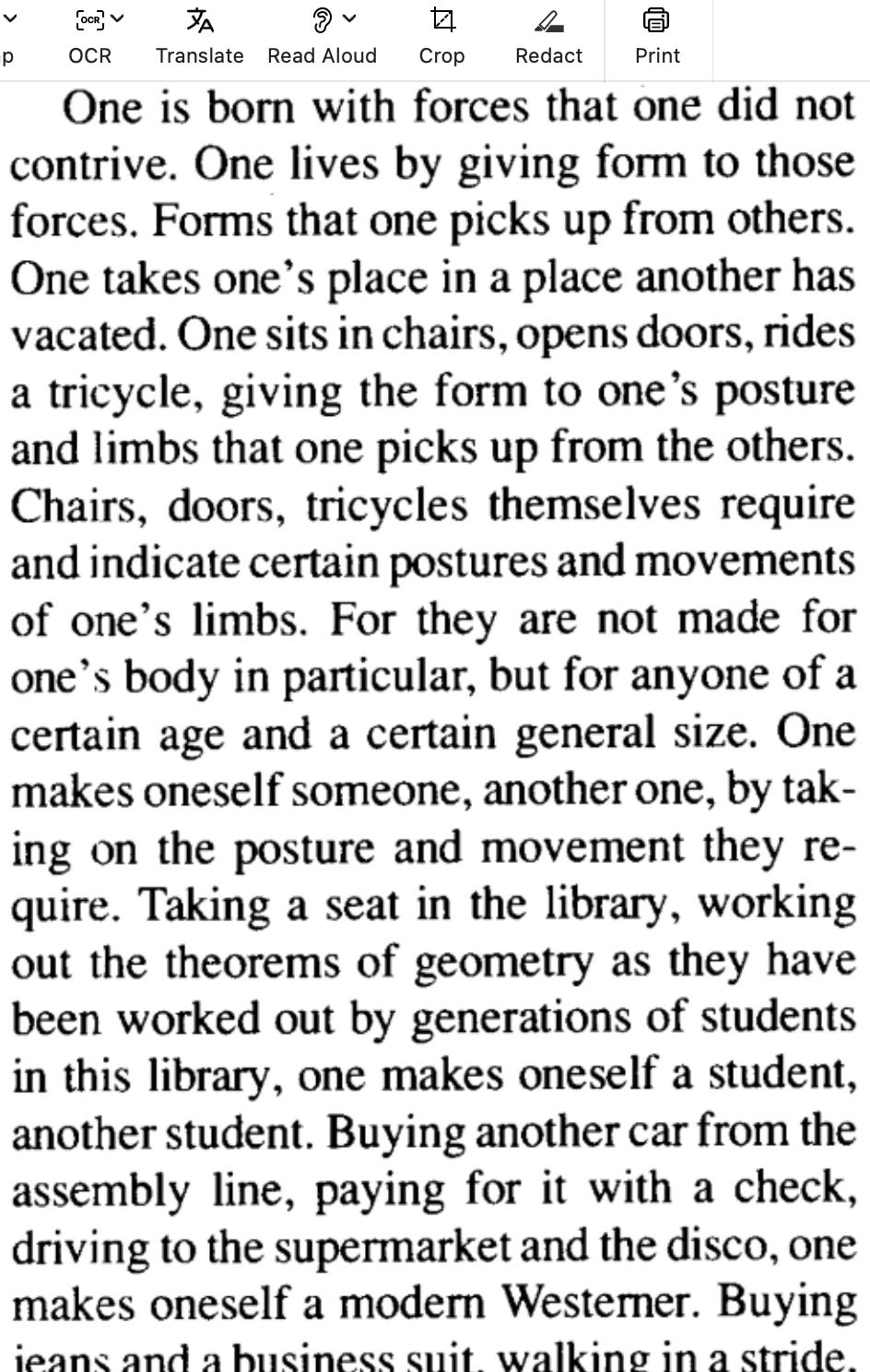
For some reason, when I love a text, I want to copyedit it. I want to take the PDF text and make it into a word document. I want to change every space between words into a pure, clean no-code space. I want to change the font, fix the line spacing, make sure it is all justified left and indented where it should be indented. I want to alter the quotation marks and punctuation order, from “this kind of thing,” to ‘this kind of thing’. It matters to me. I see these details. As I type, I see the font, and I love or hate it. Today I am typing in Cordia New, point 12. It looks like the lines are 1.5. and I have not even fixed the document so that there are no automatic gaps before or after each paragraph. Normally, the first thing I do in any word document is change the line spacing and remove all gaps before and after paragraphs. Then I change all double quotations to single, and change the punctuation order in the entire document. Then I can calm down a little bit. But this is going on Substack, and Substack will do its own thing with the font and line spacing and gaps between paragraphs.
To me, copy-editing is an act of love, and act of care, an act of learning. I know copy and paste has always had a bad reputation, but it has always been the way that I have learned.
I did my PhD before scanning was easy. Scanners were the stuff of dreams. I used to read a chapter of Derrida, underline bits and then clip the book open, typing out long passages of Derrida into my own word documents. I have probably spent years of my life doing this. This is how I learned so much about Derrida.
When scans came along, I would do the same. I had the PDF, but I needed some or all of it to be in a word document that felt like it was truly mine. I have to have been through every word, checking every letter. Then I can rest. And then, years later, I rediscover my files and lament the fact that I have forgotten so much. I took the time and care over these words because they were so powerful to me. And I worked with them so closely. And then I closed the file and forgot about them, sometimes without ever even using some of the best passages in any of my own writing.
Maybe I didn’t choose this path, this relationship. And maybe it’s not innate in me somehow. When I started my PhD, I was invited to be an editor of the journal Parallax. Here, I break tradition and write it with a capital-p and in italics. The first editors insisted that Parallax should be rendered lowercase and in bold: parallax. I notice that nowadays, the name is written with a lowercase p but in italics. So much for the insistence of the original editors.
The first task the editors gave me was proofing – comparing a word printout to a typeset or copyset printout. I loved the work. As someone who struggles to concentrate, especially on reading, having to read words and phrases twice was enough of an intensification that it helped me to concentrate. Unless I have to do it twice, I might not do it once. I am the same today. I cannot ‘just read’. I have to be doing something else at the same time. I struggle to read sitting in a chair, but if that chair is part of a train carriage and the train is moving, then I am doing two important things at the same time and hence can settle into reading.
I cannot read well unless I am proofing and copy-editing. I am not reading a text unless I am pulling bits out of it, or making sure that all of it is perfect.
I think that’s why I have edited so much. So many issues of Parallax, issues of Social Semiotics, Postcolonial Studies, JOMEC Journal, Educational Philosophy and Theory, Martial Arts Studies, and so on. And, of course, books. For Interrogating Cultural Studies, I transcribed many thousands of words while being barely able to type faster than a few words per minute. I’d listen to a couple of seconds of the interview recordings I’d made on my Dictaphone, type the words, rewind, check, and correct the inevitable mistakes. But The Rey Chow Reader was probably the most laborious. I used my shitty cheap scanner to scan the chapters. This meant that the far ends of every line of the left-hand page and the near ends of every right-hand page were bent beyond text recognition, so I was manually typing at least several words into every single line.
It was work, but it was love. I did the work because I loved the words. To me, proofing, formatting, copy-editing, changing the font, paying attention to every detail, is an act of great reverence, great respect.
While reading ‘We Mortals’ yesterday, I became irritated that I could not easily do any of this. Yet, I have no ‘need’ of a word document of this essay. I have nothing in particular to do with it. I am not editing a collection of Lingis’s writings. But still, I ended up screen-shotting every section of each column, pasting each consecutive screenshot into a word document, saving that as a PDF, running OCR text recognition on that, selecting all, copying, pasting, and now – what I am mainly doing today – working through that finally liberated text and reconstituting it as a beautiful word document. I will decide the font later.
I will learn more about Lingis by doing this than from reading as many of his essays as possible.
Of course, I have also done that. I read ‘We Mortals’ first, and then quickly read as many other works by him as possible. But this is different. That wide reading is a necessary stage. For me, the ultimate, is coming back to the detail, an intimacy with the text. Like in tai chi, like in martial arts, like with language, like in lust, you first explore the terrain, hurriedly, hungrily. But ultimately, true insight and making it yours, making it become part of you, comes from living as deeply as possible, as intimately as possible, in the folds, small spaces and precise punctuation marks of the text that you love, that you want to learn or live or think with or think through. In this way, I take things into me, make them mine, let them change me.
Coda
I know this little doodle of a work will have typos in it, inconsistencies, errors. I don’t care too much about that. That’s not the point.

Comments
Post a Comment